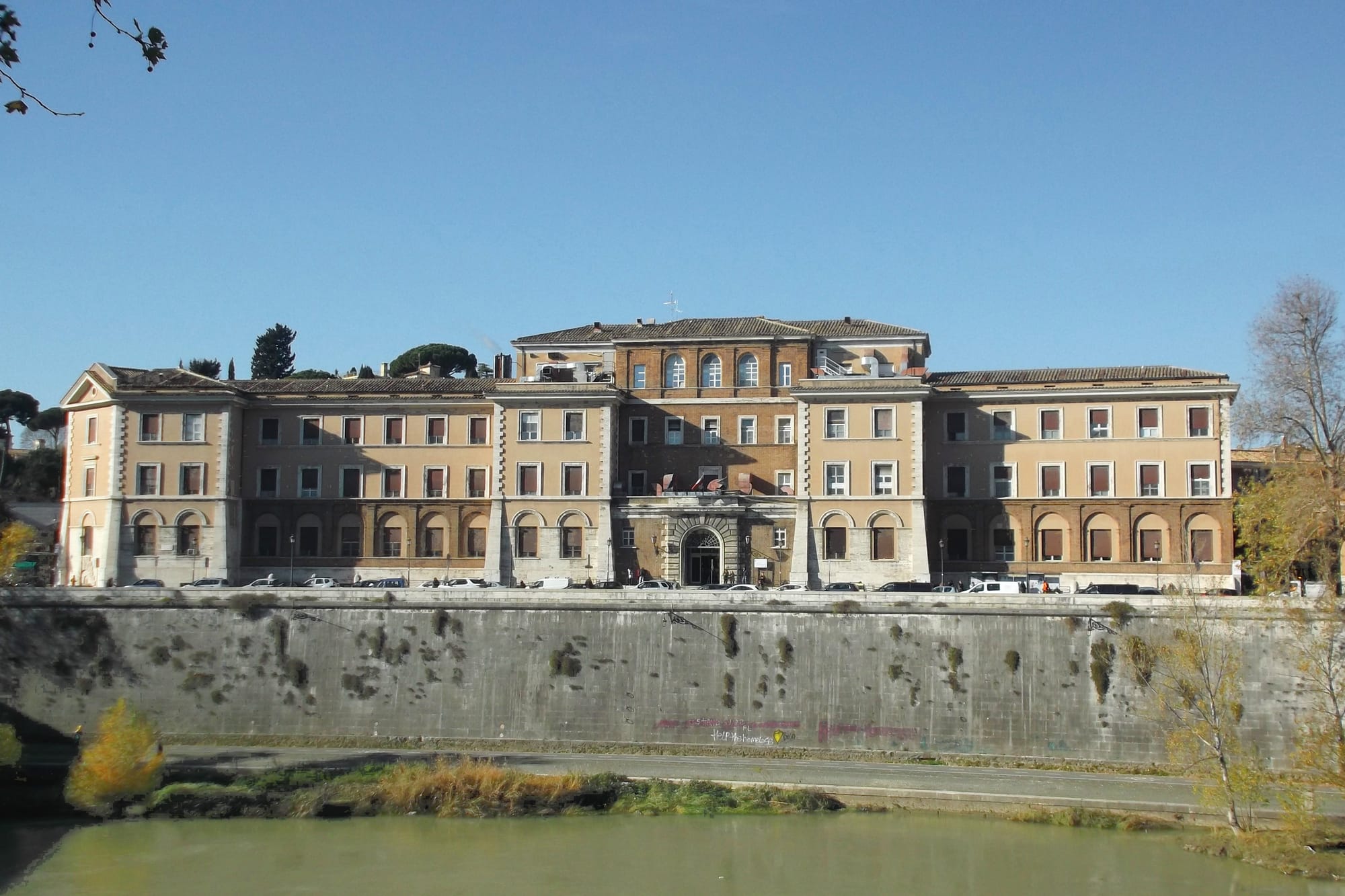
Above: The Santo Spirito in Sassia hospital, Rome. (Photo: Blackcat, via Wikimedia Commons (CC BY-SA 4.0))
A site that made global news in 2023 for the ruins of Emperor Nero's theatre has now produced something quite different: twenty Anglo-Saxon coins, found near the Vatican, in what researchers say is the first physical trace of Rome's English quarter.
The find comes from the walled garden of the Palazzo della Rovere. Archaeologists began excavating deep beneath it in 2020. The work was directed by the Soprintendenza Speciale Archeologia Belle Arti e Paesaggio di Roma and carried out by MDM Archeologia srls, under the supervision of Renato Sebastiani and Alessio De Cristofaro.
What was found
According to the University of Cambridge, the coins are 19 silver pennies and one halfpenny, minted over about 40 years in the names of three kings: Edward the Elder (899–924), the son of Alfred the Great, and Alfred's grandsons Æthelstan (924–39) and Eadred (946–55).
Fourteen came from rubbish pits, in two clumps of 6–8 coins that a thousand years in the ground have fused together. The other six lay scattered around them. The dig also turned up ten more coins, some Roman and some tenth-century Italian, and evidence of leather-, bone- and metalworking.
Rory Naismith, Professor of Early Medieval English History at Cambridge, and Francesca Tinti, Professor of Medieval History at the University of the Basque Country, building on initial research by Cecilia de Leone, studied the coins and identified where in England they came from: East Anglia, Kent, London and the West Midlands. Their findings appear in a chapter co-written with Marzia Di Mento, Valentina Pica and Filippo Salamone, published in a new book in Italian on foreigners in Rome between 300 and 1000.
"The coins aren't pretty but they have a lot to say," says Naismith.
The Schola Saxonum
The English quarter, the Schola Saxonum, was already known from texts. Medieval sources refer to an Anglo-Saxon quarter in this area from the second half of the 8th century, record two 9th-century fires, and place the community's worship in a church dedicated to the Virgin Mary. Burgred, King of Mercia from 852 to 874, was said to have been buried there after being exiled from England by the Vikings.
What had been missing was anything physical. "Before this big discovery, we never had any material remains of the English quarter in Rome," says Tinti. "We've been hoping this moment might come for most of our careers."
The quarter lay within the Leonine City, the area between the Vatican and the Tiber that was walled after a pirate raid in the 840s. Cambridge says it occupied a finger of land pointing directly at St Peter's, with nearby bridges that made crossing the Tiber convenient. How big the whole Schola was is not known, but the area of craft activity covered at least 3,000 square metres, roughly half a football pitch.
A few place names in Rome still hint at the quarter. The riverside road between the Tiber and the Vatican, the Lungotevere in Sassia, is named after the Schola Saxonum, and the Santo Spirito in Sassia hospital carries on the care the area once gave Anglo-Saxon visitors.
Shoppers and craftspeople, not a hoard
The coins were found singly or in small clusters, scattered rather than buried as a deliberate hoard. Naismith and Tinti argue this makes them clear evidence of trade. Nothing on the site suggests silver was being melted down, which is why the researchers are confident the coins were dropped by people working and shopping there, rather than lost while being converted into local money.
Halfpennies of this period are rare finds. The researchers argue this one is telling, because small change of this kind is associated with trading hubs where lots of lower-value money changed hands.
Taken with the leather-, bone- and metal-working finds, Cambridge's account is that the Schola was a working neighbourhood of makers and traders, not only a stopover for pilgrims. Naismith describes "a fairly big community, probably hundreds of people, living there on a permanent basis", keeping "a miniature Anglo-Saxon town going". His picture of "craftsmen arriving from Winchester, London or York and setting up shop by the Tiber" is, in his own words, something you can "easily imagine" rather than something the finds document.
Did the English get their own money?
This is the most interesting claim. Documents from Rome in this period generally refer only to papal coinage, and a long-held assumption holds that the papacy forbade foreign currency in the city. In a 9th-century letter, a Frankish abbot frets about the need to change currency before a trip to Rome.
Yet, Naismith says, "More Anglo-Saxon coins from this period have now been found in Rome than papal coins." He adds: "You don't find other foreign coins in Rome from this period. It seems to be very much an English thing." One of the newly identified coins is papal, which the researchers read as the two currencies being used side by side.
Their conclusion is that English visitors appear to have been given special treatment. Tinti puts it this way: "We knew they had the privilege of being able to bury their dead in this area and now, it seems, they were permitted to use their own currency."
That is an interpretation, and a carefully hedged one. Cambridge notes that Asser, Alfred's biographer, reports that in 883 Pope Marinus I freed the Schola Saxonum "from every tribute and toll" at Alfred's request. The researchers caution that this does not prove Alfred secured a currency deal, though it is a possibility, and we now know his son's coins were in use in Rome.
For the kings, the researchers argue, having their coins used so close to St Peter's brought significant prestige, and showed people at home that their rulers could facilitate pilgrimages.
A long relationship
The find sits within a long connection. England's ties with Rome went back to the late 6th century, when Pope Gregory I arranged a mission to the English. From the late 8th century, Naismith says, the relationship became more formal, when Offa of Mercia (757–96) instituted an annual payment of 365 gold pieces to the papacy to keep the candles burning in Rome's churches. In the 10th century, Peter's Pence developed, with every English household, at least notionally, giving a penny as alms for Rome. In 1027, King Canute visited Rome, in part to continue the tradition of negotiating financial benefits for English pilgrims.
My own reading: the coins matter less for their value than for what they replace. A community known only from documents now has a rubbish pit, a halfpenny and a scatter of lost pennies, the ordinary debris of people buying and selling. Whether those pennies were a papal privilege remains a hypothesis, but the question can now be argued from physical evidence.
The coins and other finds are the property of the Italian state.
Sources
Di Mento, M., Naismith, R., Pica, V., Salamone, F. and Tinti, F. (2026) 'Ricerche nell'area della schola Saxonum', in Spera, L., Santangeli Valenzani, R. and Menna, R. (eds) Rome and the Others (300-1000). Foreigners in the city between conflicts and integration - Roma e gli altri (300-1000). Stranieri nella città tra conflitti e integrazione. Atti del Convegno Internazionale PRIN 2022 (Roma, Università RomaTre, Aula Magna, 11-12-13 dicembre 2025). Quingentole (Mantova): SAP Società archeologica, pp. 489-505.
University of Cambridge (2026) 'Anglo-Saxon expats got special treatment in Rome's "Little England", coin discovery reveals', University of Cambridge, 1 October 2026, available at: https://www.cam.ac.uk/stories/anglo-saxon-expats-in-romes-little-england (Accessed: 8 October 2026).