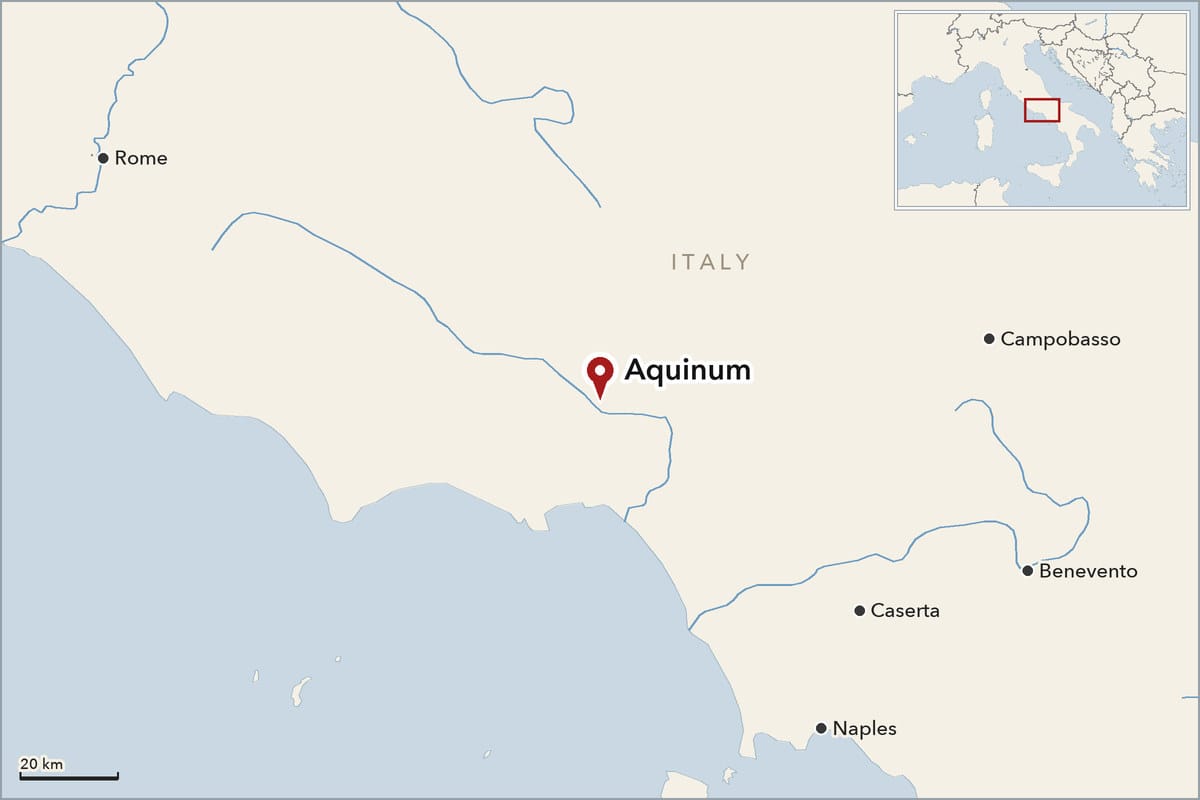
On 3 October 2026 the University of Salento showed the public two finds from its 18th excavation campaign at Aquinum, a Roman colony in the municipalities of Castrocielo and Aquino, in Frosinone province. The university's press release of 4 October describes them as "two exceptional discoveries" ("due eccezionali scoperte"). One is a decorated stone marker, the other a marble altar. Both were presented at the Archaeology Weekend that closed the season.
The dig is directed by Giuseppe Ceraudo, professor of Ancient Topography at the University of Salento. According to the press release, it has run for eighteen years and works with the Superintendency for Frosinone and Latina and the municipalities of Castrocielo and Aquino.
A cippus that may remember a sacrifice
The first find is a richly decorated cippus, a stone marker. The university says it was reused as paving near one of the ancient city's main intersections. It carries a dedicant's name, probably Caius Ammius Cammarus, though the release says the full reading is still to be established with certainty. Garlands, festoons and bucrania frame three animals: an ox, a ram and a pig.
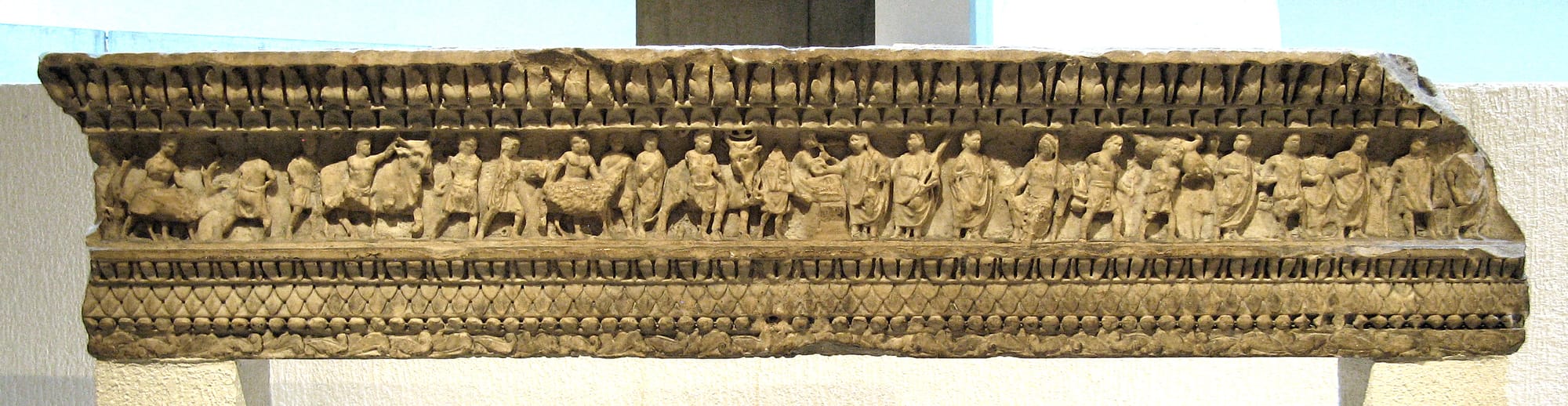
Those three animals recall the suovetaurilium, one of the most solemn rites of Roman religion, in which a pig (sus), a sheep (ovis) and a bull (taurus) were sacrificed. The release says the carving may not be merely decorative and may preserve the memory of a sacrifice or evoke one, perhaps linked to purification, consecration or the ritual marking out of a space.
The release is explicit that the interpretation must stay cautious, chiefly because the stone was found away from its original position. That is the weak point in the case. A monument reused as paving has lost its original setting, and with it much of the evidence for what it marked. The animals are clear enough; what the stone was set up to commemorate is not.
An altar that names its gods
The second find is a marble votive altar. A newly found fragment allowed the university's team to recompose an inscription previously known only in part. The more fully recovered text shows the altar was consecrated to the Genius of Augustus, the Lares of Augustus and the Genius of the Colony.
The dedication was made by Manius Popidius Anteros, described in the release as a wealthy freedman who held the office of sevir Augustalis. The university says the altar points to a colony in which worship of the emperor and the imperial house was intertwined with the cult of the civic community.
Other results
The release lists further results from 2026:
- A lightning slab at the theatre. A marble slab found in the Roman theatre bears the formula FVL(GVR) C[ONDITVM], tied to the ritual by which Romans buried and consecrated a place struck by lightning. The university calls it a rare testimony and says it could indicate that the theatre itself was hit by a weather event read as a sign of divine will. Further study will be needed to establish how the inscription relates to where it was found and to the history of the theatre building.
- Five restored heads. The weekend also presented the recent restoration of five marble heads, including the so-called Caesar of Aquinum and a portrait head attributed to Drusus the Elder.
- First digs in Aquino. The season included the project's first excavations in the municipal territory of Aquino, alongside the long-running work in Castrocielo.
What the team says
"After eighteen years of research, Aquinum continues to surprise us," Ceraudo said in the university's release, as translated by Finestre sull'Arte. The Italian magazine also reports that Francesco Artibani, head of the Aquinum Project for the Roma Sotterranea association, said the resources invested in technology and safety had let the group support the research in concrete terms.
Sources
Capoccia, N. (2026) 'Aquino (Frosinone): The University of Salento Discovers Two Artifacts Linked to Roman Religion', Finestre sull'Arte, 5 October 2026, available at: https://www.finestresullarte.info/en/archaeology/aquino-frosinone-the-university-of-salento-discovers-two-artifacts-linked-to-roman-religion (Accessed: 4 November 2026).
inITALY Redazione (2026) 'Aquinum: two exceptional finds uncovered by UniSalento excavations', inITALY, 4 October 2026, available at: https://www.initaly.it/en/articolo/aquinum-due-reperti-eccezionali-emersi-negli-scavi-uni-salento-39198 (Accessed: 4 November 2026).
Università del Salento (2026) 'Aquinum, due eccezionali scoperte', Comunicato n. 182, Università del Salento, 4 October 2026, available at: https://www.unisalento.it/-/aquinum-due-eccezionali-scoperte (Accessed: 4 November 2026).
Picture credits
- Top picture: A Roman relief of the sacrificial triad of pig, sheep and bull. It is not the Aquinum cippus. Frieze of suovetaurilia from Beaujeu (Lugdunum, Musée gallo-romain de Fourvière, Lyon), photo: Mark Landon, CC BY 4.0 (source)
- Map: drawn from Natural Earth (public domain) and Wikidata.
