A small bearded face on a fragment of terracotta coffin lid is the centre of a study by Bilge Yılmaz Kolancı, whom news reports identify as an associate professor at Pamukkale University. It was published in volume 14 of Cedrus: The Journal of Mediterranean Civilisations Studies, pages 309–322, and the Zenodo record lists it as available on 12 October 2026. The article describes a cylindrical terracotta sarcophagus found at Attouda, in Denizli Province, western Türkiye. Its lid carries a high-relief head of Silenos, a figure the study associates with the cult of Dionysos.
The piece is good evidence of what a surface survey can recover. It also shows how little can be said once agricultural work has disturbed the ground it lay in.
Where it was found, and what state it was in
According to the study's abstract, the sarcophagus was identified during surface surveys at Attouda in 2023. The abstract places the ancient city within the Hisar Neighbourhood of the Sarayköy district. Arkeonews, Anatolian Archaeology and Science.Report all locate the fragments in the Musalla area, south of the ancient settlement, in agricultural land.
Farming had disturbed the find, and the pieces had been separated from their original setting. Arkeonews reports that the six surviving fragments were later transferred to the Denizli Museum. Science.Report says two of the six come from the cylindrical body and four from the lid.
That disturbance limits the dating. The abstract says a precise date cannot be established because no associated grave goods were found. It proposes, on the basis of parallels, that the sarcophagus was made in the 1st–2nd centuries CE. Science.Report describes that as a comparative date, not a direct measurement of the terracotta. Arkeonews's headline calls the object 1,900 years old, which is a rounding of that proposed range and not a measured age.
What the fragments show
Arkeonews reports that the sarcophagus was made of reddish clay containing mica and limestone particles. It gives the estimated original diameter as 55–60 centimetres, and Anatolian Archaeology and Science.Report give the same range. Anatolian Archaeology also mentions raised bands and horizontal handles. Arkeonews says these resemble features on terracotta sarcophagi from Laodikeia, Hierapolis and Trapezopolis. The abstract says the formal characteristics of the fragments indicate local workshops.
The lid fragment with the relief measures about 33 by 30.5 centimetres, according to Arkeonews and Science.Report. The head itself is 4.8 centimetres high. Science.Report adds that it is 4.3 centimetres wide and 2.5 centimetres deep. Arkeonews and Science.Report describe large circular eyes, a broad nose, deeply cut lips and a short beard. Science.Report places the face at the centre of a slightly convex lid.
A Greek letter Beta (Β), about seven centimetres high, is incised on the lid, according to all three news pages; Arkeonews and Science.Report place it beside the face. Its meaning is unknown. Anatolian Archaeology and Arkeonews report that Yılmaz Kolancı considers it may be a workshop or craftsperson's mark.
What the study argues
The abstract states the central claim directly: it finds no comparable representation among known examples from Anatolia, which it says makes the piece unique. The term applies to the known examples, not to every sarcophagus ever made.
On meaning, the abstract says the iconographic analysis suggests the figure is Silenos, associated with the Dionysian cult, and that it served an apotropaic, or protective, function in the funerary setting. Anatolian Archaeology and Arkeonews report that the author also considers whether the relief sat above the deceased's face or head. Both say the damage to the sarcophagus means its original arrangement cannot be reconstructed with certainty. Science.Report says the same of the guardian reading.
Science.Report adds a caution of its own: the apotropaic reading cannot establish what the coffin's makers or the deceased's community believed. The protective function is the author's interpretation.
Dionysos at Attouda
The news pages place the relief in a local setting. Arkeonews and Anatolian Archaeology both report that another terracotta Silenos head was recovered earlier from a tomb in Attouda's necropolis. Anatolian Archaeology says it is preserved in the Denizli Museum. Anatolian Archaeology also reports that Roman-period coins from Attouda show Dionysos with familiar attributes, including a thyrsos and a drinking vessel.
These finds establish a cultural context in which the decoration would make sense. They do not tell us the beliefs or identity of the person buried in the coffin.
What can be said
A typological date, a coffin that cannot be tied to an intact tomb, and no grave goods leave the interpretation resting on iconography and parallels. The study's contribution is a described and illustrated object with a firm claim that it has no known parallel in Anatolia. The protective reading is a reasoned suggestion about it. What the broken lid cannot offer is the grave it came from.
Sources
Altuntaş, L. (2026a) 'Rare Roman Sarcophagus in Türkiye Features a Silenos Face Believed to Protect the Dead', Anatolian Archaeology, 21 October 2026, available at: https://www.anatolianarchaeology.net/rare-roman-sarcophagus-in-turkiye-features-a-silenos-face-believed-to-protect-the-dead/ (Accessed: 21 October 2026).
Altuntaş, L. (2026b) 'Unique 1,900-Year-Old Sarcophagus with Silenus Relief Identified in Ancient Anatolia', Arkeonews, 19 October 2026, available at: https://arkeonews.net/unique-1900-year-old-sarcophagus-with-silenus-relief-identified-in-ancient-anatolia/ (Accessed: 21 October 2026).
Hassett, B. (2026) 'Silenos Relief Marks a Rare Roman Coffin from Attouda', Science.Report, 20 October 2026, available at: https://science.report/discover/silenos-relief-marks-a-rare-roman-coffin-from-attouda-110106/ (Accessed: 21 October 2026).
Yılmaz Kolancı, B. (2026) 'Terracotta Cylindrical Sarcophagus with a Silenos Head Relief from the Necropolis of Attouda', Cedrus (The Journal of Mediterranean Civilisations Studies), XIV, pp. 309–322, Zenodo, 12 October 2026, DOI: 10.5281/zenodo.22305506, available at: https://zenodo.org/records/22305506 (Accessed: 21 October 2026).
Picture credits
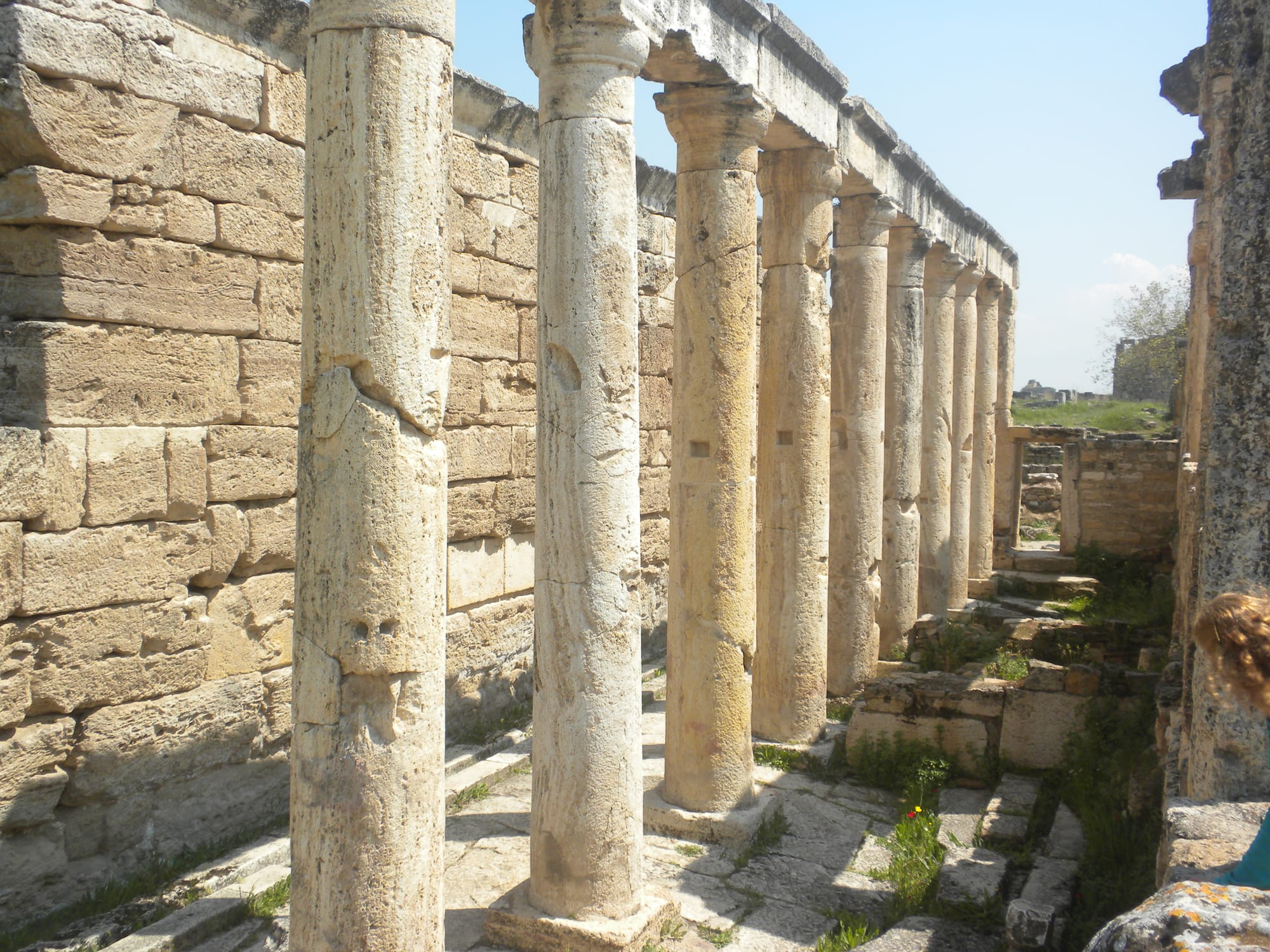
- Top picture: Hierapolis, one of the cities where cylindrical terracotta sarcophagi are known. Hierapolis ruins, Turkey — photo by [email protected] (CC BY 3.0, via Wikimedia Commons)
