How did people in ancient Italy learn to write? A 2019 article in The Journal of Roman Studies by Katherine McDonald puts forward one answer. Her evidence comes from offerings left for a goddess, not from a schoolroom.
What was left at the sanctuary
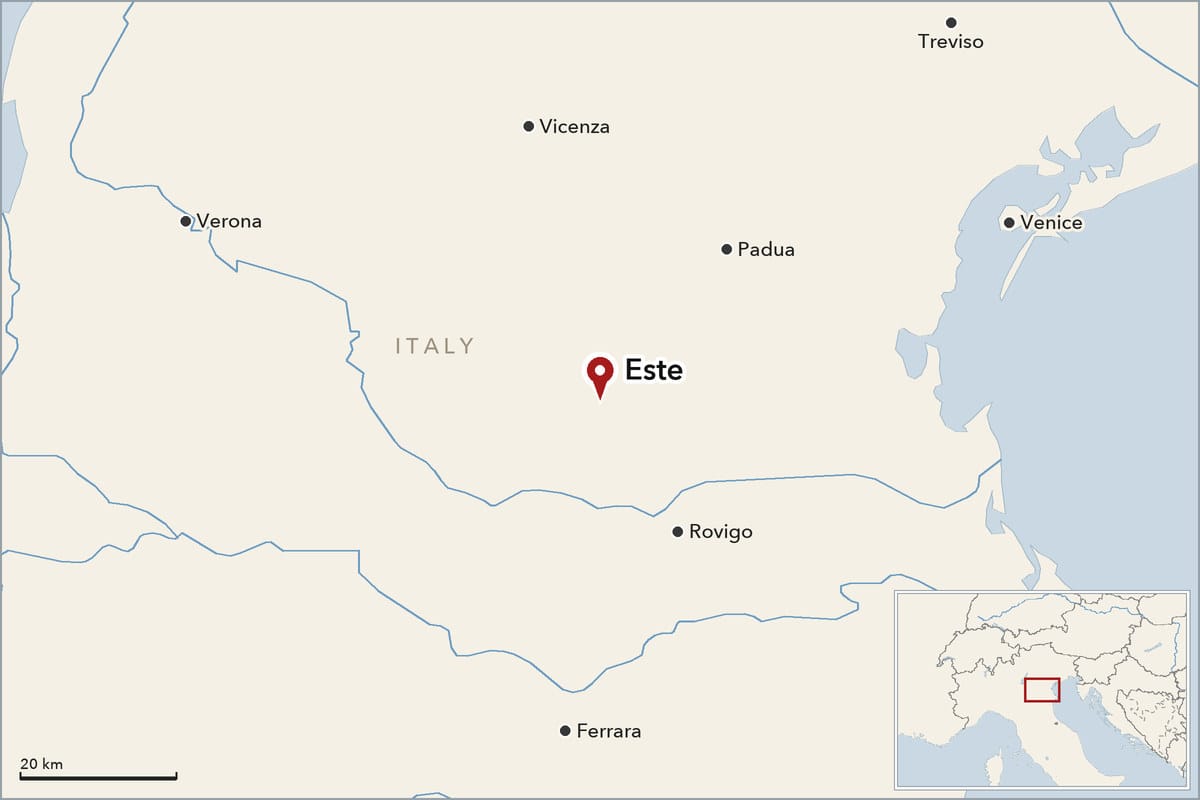
The objects are votive dedications to Reitia at the sanctuary of Este-Baratella, in the Veneto. According to the article's abstract, they take the form of bronze writing-tablets and styluses.
The inscriptions on them are in Venetic. The abstract lists three kinds of text. There are the formulae used in dedications, there are abecedaria (alphabets written out in order), and there are other writing exercises. The abstract presents the dedications as evidence for how literacy was acquired in Italy from about 350 to 150 BC.
The argument
The core claim in the abstract is that these texts work as writing exercises. On that basis, McDonald describes them as "some of the earliest evidence of elementary education methods in Italy."
The article makes a second argument, about women. According to the abstract, many of the votives were dedicated by women. McDonald uses this to argue that women took an active part in literacy and education during this period.
The study also places Este in a wider setting. It compares the Reitia dedications with deposits of abecedaria from votive and funerary contexts elsewhere in Italy and across the ancient world.
The case file
The article's acknowledgements thank the Museo Nazionale Atestino for permission to study and photograph the inscriptions it discusses. The evidence is a body of physical objects that can be examined, not a later writer's report about schooling.
At Este, by McDonald's reading, practice was kept and given to a goddess.
Two points deserve care. First, calling these texts exercises is the article's interpretation of inscriptions that include dedicatory formulae, abecedaria and other writing exercises. That interpretation is the article's case, and it is a strong one on its face. It is still an argument. Second, evidence like this shows how some people in one sanctuary's orbit learned to write over about two centuries. On its own, it cannot tell us how many did. The Este tablets open a window onto a method. They do not measure literacy.
Sources
McDonald, K. (2019) 'Education and Literacy in Ancient Italy: Evidence from the Dedications to the Goddess Reitia', The Journal of Roman Studies, 109, pp. 131–159, Cambridge Core, Cambridge University Press, published online 6 August 2019, doi: 10.1017/S0075435819000856, available at: https://www.cambridge.org/core/journals/journal-of-roman-studies/article/abs/education-and-literacy-in-ancient-italy-evidence-from-the-dedications-to-the-goddess-reitia/9A0FF30F6716A6620DAE889A8A25BD66 (Accessed: 28 October 2026).
Picture credits
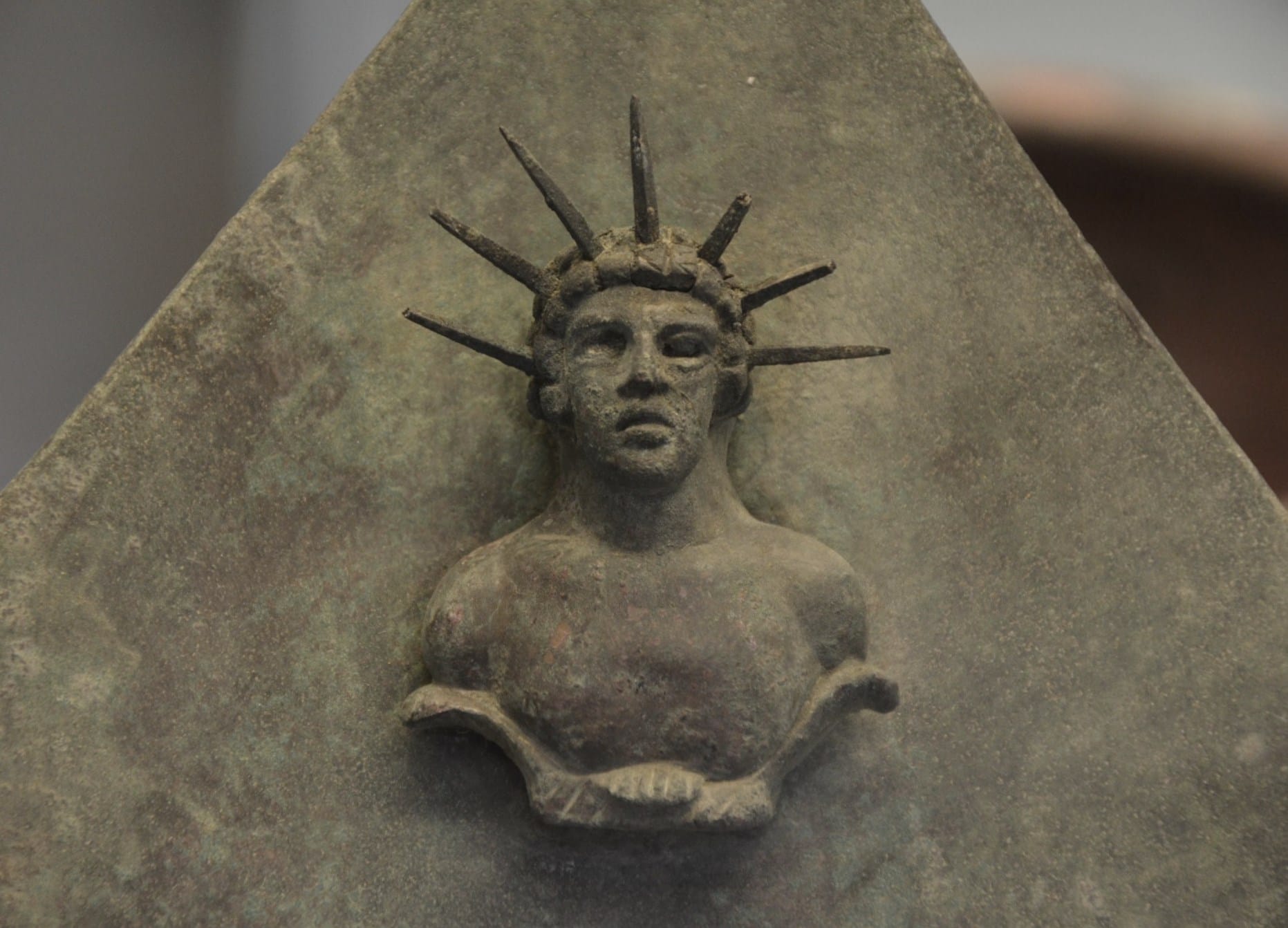
- Top picture: A bronze votive tablet with the head of Mithras in the British Museum. It is not one of the Este dedications to Reitia. Image: Bronze votive tablet with head of Mithras (CIMRM 234), British Museum — Carole Raddato, CC BY-SA 2.0, via Wikimedia Commons
- Map: drawn from Natural Earth (public domain) and Wikidata.
