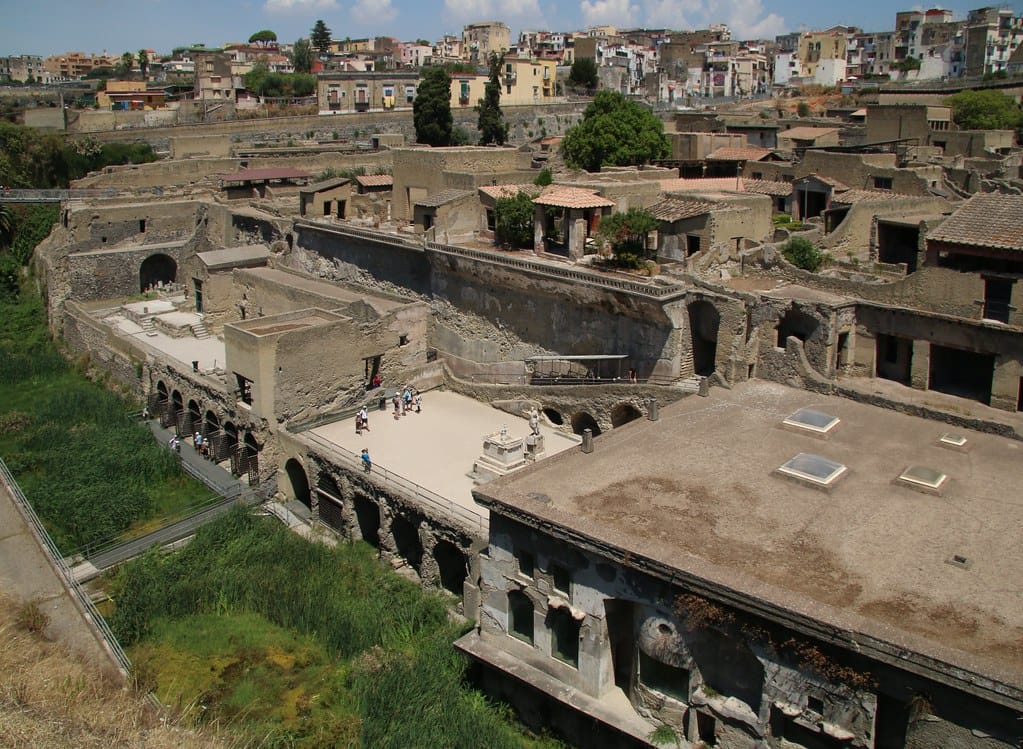
A Herculaneum papyrus that was judged unreadable in the 1980s, according to UKNow, has now been read column by column from a digital scan. The Vesuvius Challenge announced the reading of PHerc. 1667, a scroll the project's community knows as Scroll 4, on 25 June 2026. According to the project's announcement, it is the first Herculaneum papyrus to be digitally unrolled and read in full, from one end to the other, and made available for sustained scholarly study.
The text turns out to be a philosophical treatise, and the researchers' reading of it is cautious. A name in its last surviving column points towards the Stoic school. Who wrote it was still an open question when the find was announced.
What was announced
The announcement was made in Naples. UKNow, the University of Kentucky's news site, reported that lead researchers, collaborators and guests gathered at the Biblioteca Nazionale di Napoli Vittorio Emanuele III to mark the result. The project also published a preprint and released its data and code.
The Vesuvius Challenge describes how the scroll was read without being opened. The team scanned the scroll with high-resolution phase-contrast X-ray microtomography on the BM18 beamline at the European Synchrotron Radiation Facility (ESRF) in Grenoble. From the scan they reconstructed the sheet of papyrus wound inside the roll and flattened it into a readable surface. They then trained machine-learning models to pick out ink that is almost indistinguishable from the carbonised papyrus beneath it. Papyrologists examined and transcribed each reading. The work was carried out in collaboration with the National Library of Naples, which safeguards the Herculaneum papyri.
The project says the tomographic data, reconstructed surfaces and transcriptions are released under a Creative Commons licence at scrollprize.org/data, and that the code is on GitHub.
A scroll with a damaged history
PHerc. 1667 is only part of what it once was. The project says attempts to open it by hand in the nineteenth century, in 1969 and in the 1980s destroyed its outer layers and left the compact inner core. That core is about 8 cm tall; the roll's original height was 19 to 24 cm.
Federica Nicolardi, a papyrologist at the University of Naples Federico II who leads the Vesuvius Challenge's papyrology team, told UKNow: "This scroll was deemed completely unreadable when part of it was opened in the 1980s." She said a few isolated letters were visible, that overlapping layers obscured the writing, and that the scroll was assigned a readability score of zero. UKNow adds that records from 1782 already give it today's height but a diameter more than twice as large, so the later attempts reduced its width; it is now about 2 cm across.
The project's announcement describes roughly 1.4 metres of papyrus and around twenty-two columns of Greek text.
What the text says
The project describes the recovered text as the lower parts of the columns, transcribed and reviewed by papyrologists. Because the papyrus is damaged, the readings are fragmentary and have gaps where the surface is lost.
The content is a treatise on ethics. The project says it turns on human nature, impulse and the moral progress of human beings. UKNow reports that the text discusses core Stoic concepts, including hormē, or impulse, and that another key concept is phronēsis, or practical wisdom, which the papyrologist Maria Chiara Robustelli describes as the highest virtue "when framed in a Stoic context". In one passage, UKNow reports, the author writes: "We will inquire into something, but we will not grasp it, if in some way we depart from ourselves and from our own nature."
On dating, Nicolardi told UKNow that the handwriting and internal references suggest the second century BC or possibly the late third century BC. The project's announcement gives the 2nd century BC.
Who wrote it
The name that carries the case is Aristocreon. The project says the final preserved column names Aristocreon, the nephew and disciple of the Stoic Chrysippus, and that this, together with the language and themes of the text, places the work in a Stoic context.
The researchers quoted by UKNow do not treat that as an identification. Nicolardi said: "If this text had been found in Egypt or anywhere else, it would probably have been classified straight away as a Stoic text. The fact that it comes from a collection that is almost entirely Epicurean makes us more cautious in drawing conclusions." She added that if the text is a Stoic treatise, Chrysippus would be "a good candidate for authorship", and that the mention of Aristocreon, Chrysippus' nephew and pupil, "might point in the same direction". UKNow reported on 26 June that the title and author were unknown.
Alessia Lavorante, another member of the papyrology team, told UKNow that the Herculaneum collection also includes Epicurus himself and other Epicurean authors whose dates fit the chronology, as well as books by Chrysippus. She said the scroll could be by one of them or by someone entirely new. UKNow adds that both the early date and the contents suggest a writer other than Philodemus of Gadara, whose works predominate among the Herculaneum finds so far.
My own reading is that this is a lead rather than a verdict. A relative's name in the last column and a Stoic vocabulary make a reasonable case for where the text belongs. They do not say who composed it, and the team members quoted say as much.
Two more scrolls
The announcement covers two further scrolls. In PHerc. Paris. 4, known to the community as Scroll 1, the project says higher-resolution imaging made the ink directly visible in the three-dimensional X-ray data for the first time. It says that ink matches the text read for the 2023 Grand Prize one to one.
In PHerc. 139, the project says the team recovered a title and author attribution: Philodemus, On Gods, Book 8. UKNow reports that this establishes for the first time that On Gods was a work of at least eight books, since only the first book, PHerc. 26, had been known. UKNow says the presence of Philodemus's name allows the scroll to be dated between the first century BC and the first century AD.
What comes next
The project says hundreds of scrolls remain sealed and that the method is built to scale. UKNow puts the figure at more than 600 unopened Herculaneum scrolls. It also reports that Brent Seales, a co-founder of the Challenge and the Stanley and Karen Pigman Chair of Heritage Science at the University of Kentucky, described a change in what is needed. "This is no longer just about imaging or machine learning," Seales said. "Now we need experts who can read, edit and understand what they are saying."
The announcement also notes that most of the Vesuvius Challenge research team first arrived as contestants in the open competition.
Sources
Piercy, L. (2026) 'The day the Herculaneum scrolls began speaking again', UKNow, University of Kentucky, 26 June 2026, available at: https://uknow.uky.edu/research/day-herculaneum-scrolls-began-speaking-again (Accessed: 25 October 2026).
Vesuvius Challenge (2026) 'We read an entire scroll — without ever opening it', Vesuvius Challenge, 25 June 2026, available at: https://scrollprize.org/firstscroll (Accessed: 25 October 2026).
Picture credits
- Top picture: The ruins of Herculaneum. Image: The ruins of Herculaneum, by Steve Knight (kitmasterbloke), CC BY 2.0, via Flickr (source)
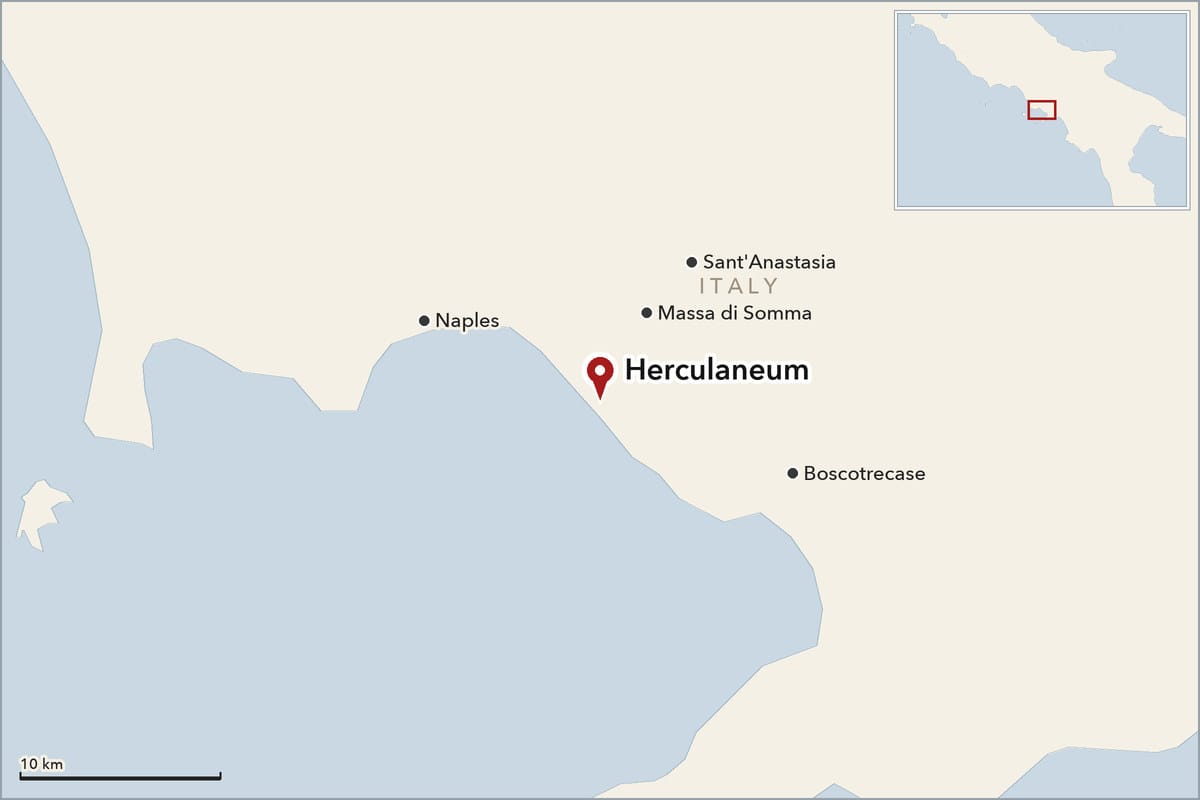
- Map: drawn from Natural Earth (public domain) and Wikidata.