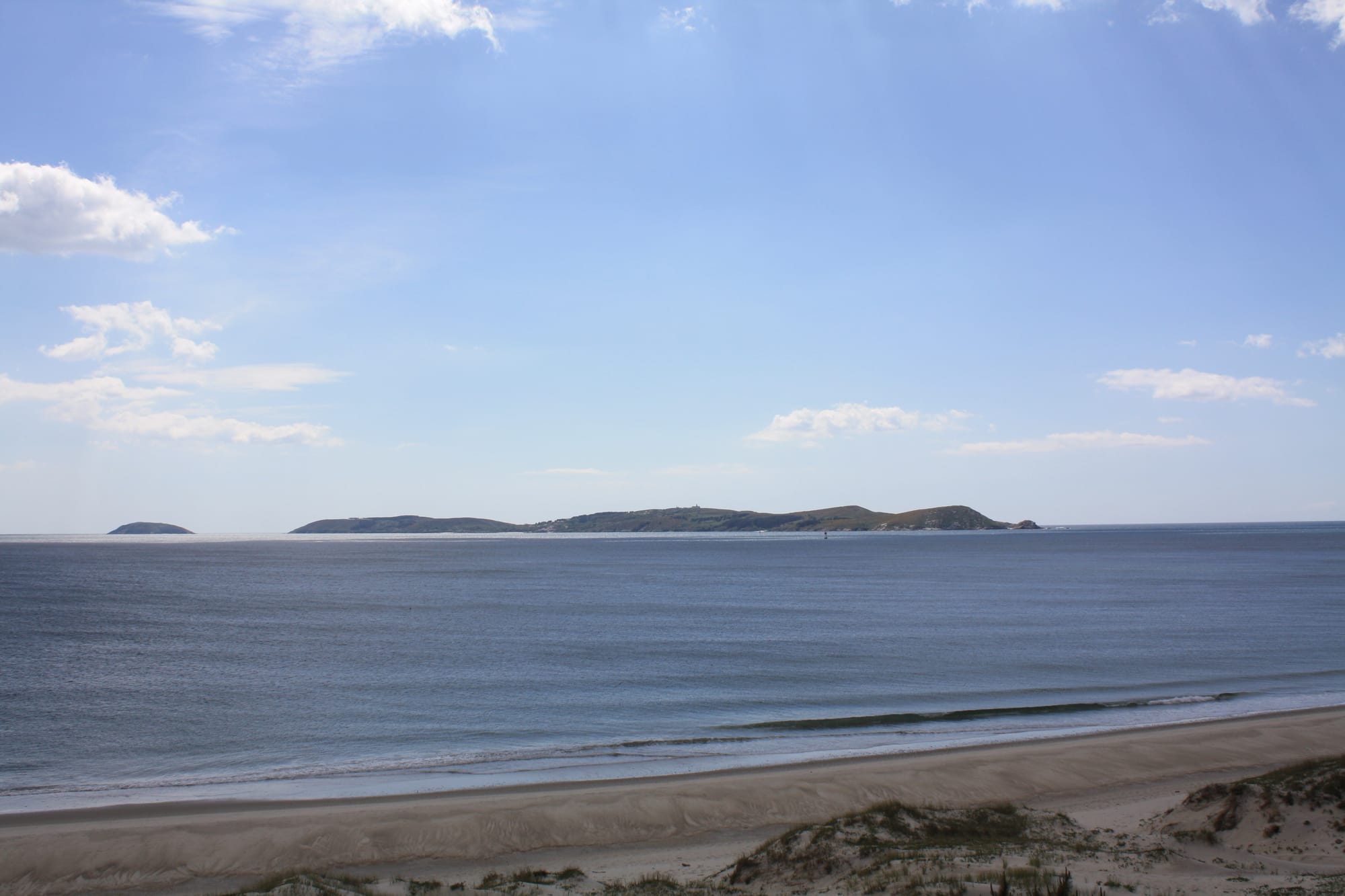
The best case files are the ones where the tidy account stops fitting. At Castelo dos Mouros, a hillfort on Ons Island off the coast of Galicia, an excavation has put an apparently older wall under a Roman room, in a spot where only Roman remains had been found before.
On 19 October 2026 the Xunta de Galicia announced the result of the latest dig it carried out with the University of Vigo. According to the release, reproduced on the news site GaliciaXa, the team had finished its work a few days earlier. Its main discovery was a wall of "aparente cronoloxía castrexa", which is to say apparently of the Iron Age hillfort (castro) culture. The wall lies outside the castro's rampart.
What the team says it found
The work was done by the University of Vigo's Group for the Study of Archaeology, Antiquity and Territory (GEAAT). It was the second phase of a project that began in May 2026 and was financed by the Galician environment ministry through the Illas Atlánticas national park. This phase aimed to finish the excavation and to carry out conservation work on the site.
In the spring, according to the release, the team had dug east of the fortified area and learned more about Roman occupation outside the castro. When work resumed this autumn, the Roman building there was confirmed. Beneath the levels of use of one of its rooms, the team located the wall that the release calls "the great novelty" of this phase. The release describes it as the first Castrean remains found outside the castro.
Faro de Vigo reported that the excavation's director, Alba Rodríguez, said the earlier spring work had already hinted that the settlement extended beyond its defences. It also reported her saying that only Roman structures had previously been located outside the castro.
Why the position matters
Earlier campaigns had suggested a division of space. Per the release, finds from those campaigns showed Castrean people occupying the area inside the rampart, while Roman settlement sat lower down, on the slope descending to Canexol beach. Remains of fish-salting factories were identified there. A wall of apparently earlier date under a Roman room in that outer zone sits awkwardly with a neat inside/outside split.
The team's own reading is cautious. The researchers consider that further campaigns will be needed to establish how occupation in this space was arranged. They say the find strengthens the hypothesis that this area was occupied continuously and in a complex way.
Science.Report, which covered the find on 19 October, stresses what a wall under a floor does and does not show. A feature lying beneath a later occupation layer is generally earlier than that layer, it explains, provided the deposits have not been disturbed or reworked. That gives a sequence, not a calendar date. Science.Report described the Iron Age identification as a preliminary interpretation and said the wall's precise date and function remain to be established. That is a fair summary of where the case stands. The wall is older than the Roman levels above it, and "aparente cronoloxía castrexa" is the team's working label for how much older.
The terrace above
The 2026 work also concentrated on the castro's intermediate terrace, where Iron Age structures had already been located. According to the release, the team kept excavating a hut found in 2025, which had also revealed three other dwellings that were only partly dug. This autumn the largest of those was finished. It is a roomy house that preserves a possible central combustion structure, interpreted as a hearth, and a second structure made of slabs set upright in the ground. The function of the slab structure is still under study.
The team also documented a new wall with a curved plan, bringing the number of dwellings identified on the terrace to five. The researchers take this as confirming intense occupation of that sector during the Iron Age. The wider project, running since 2021, has indicated that Castelo dos Mouros was densely inhabited for nine centuries, with different settlement strategies over that time.
Conservation and outreach
Faro de Vigo reported that after the dig, a restoration team led by Iria Veloso stabilised one of the walls excavated outside the rampart, which it described as being in a delicate state of conservation. According to the release, the aim is to protect the castro, allow research to continue and contribute to the site's eventual museum presentation.
The campaign also had a public side. The release says the archaeologists shared part of a working day with 60 new specialised guides for the national park, who had completed a course promoted by the Xunta. Students from the Galician higher school of conservation and restoration of cultural heritage also visited the site.
Where it stands
As of 19 October, the Xunta's account was of a find made and recorded, with the interpretation still open. What the team calls its Iron Age character is still an apparent attribution, to be tested in later campaigns.
Sources
Faro de Vigo (García, D.) (2026) 'Las excavaciones en la isla de Ons hallan un muro de época castreña por fuera de la muralla del Castelo dos Mouros', Faro de Vigo, 19 October 2026, available at: https://www.farodevigo.es/o-morrazo/2026/10/19/excavaciones-isla-ons-hallan-muro-135515031.html (Accessed: 21 October 2026).
GaliciaXa (2026) 'A Xunta e a UVigo finalizan a intervención arqueolóxica na illa de Ons cun novo achado' (reproducing the Xunta de Galicia press release), GaliciaXa, 19 October 2026, available at: https://galiciaxa.com/news/a-xunta-e-a-uvigo-finalizan-a-intervencion-arqueoloxica-na-illa-de-ons-cun-novo-achado/138189/ (Accessed: 21 October 2026).
La Voz de Galicia (2026) 'Hallan nuevos vestigios de presencia humana en la Edad de Hierro en la isla de Ons', La Voz de Galicia, 19 October 2026, available at: https://www.lavozdegalicia.es/noticia/sociedad/2026/10/19/hallan-nuevos-vestigios-presencia-humana-edad-hierro-isla-ons/00031792431602222434724.htm (Accessed: 21 October 2026).
Science.Report (Hassett, B.) (2026) 'A Roman Room May Sit Above an Iron Age Wall', Science.Report, 19 October 2026, available at: https://science.report/discover/a-roman-room-may-sit-above-an-iron-age-wall-109686/ (Accessed: 21 October 2026).
Picture credits
- Top picture: Ons Island, off the Galician coast. The Ons Islands, from the coast of Sanxenxo — photo by P.Lameiro (CC BY-SA 3.0) (source)
