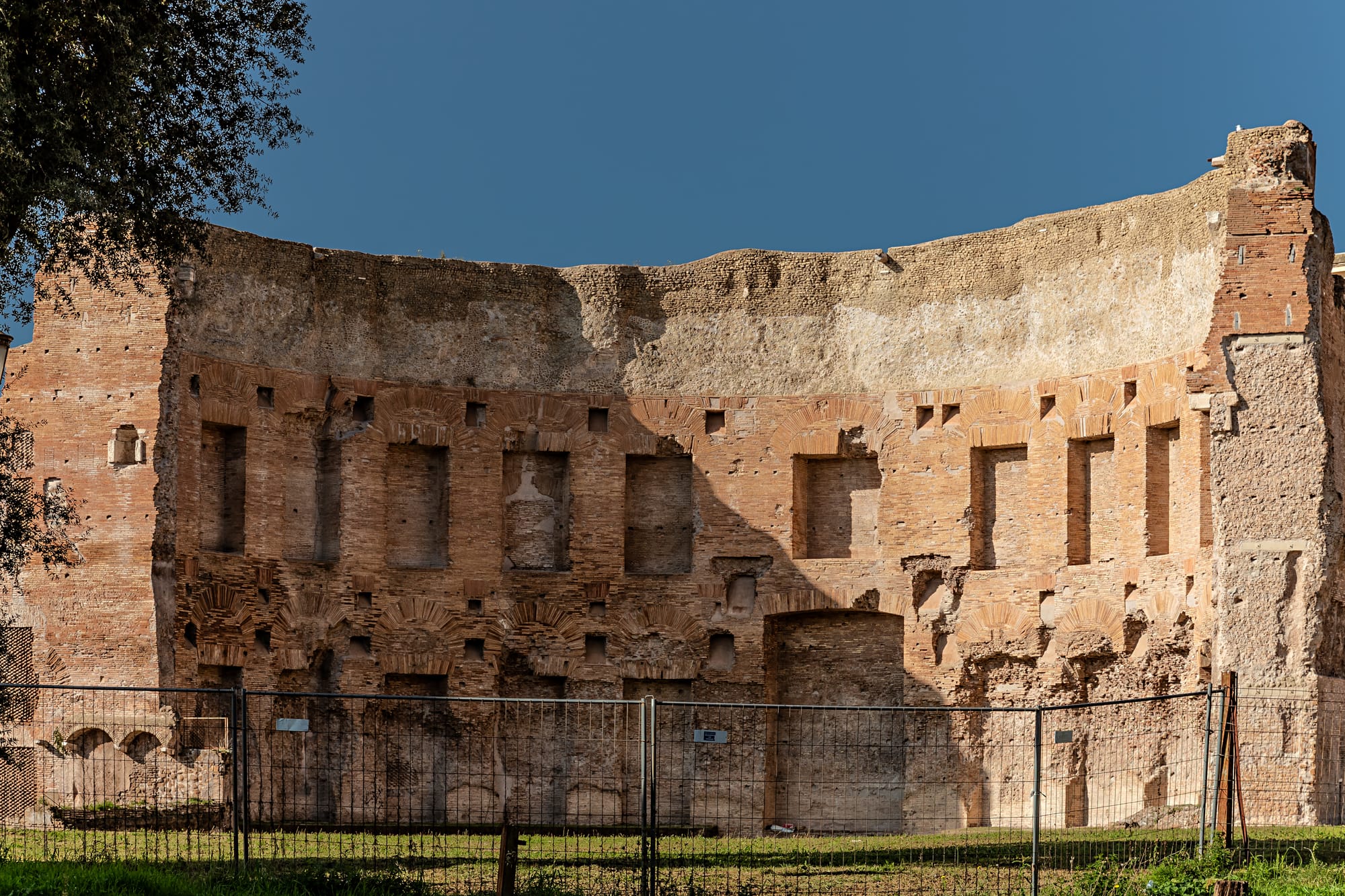
On 8 September 2026, Rome's authorities announced that the restoration and enhancement of the great exedra and underground gallery of the Baths of Trajan on the Oppian Hill (Colle Oppio) was complete. The work was carried out under the Caput Mundi programme. Two ancient decorations lie at the centre of it: a fresco known as the Painted City and a wall mosaic known as the Great Mosaic. A figure for the mosaic's size has circulated in coverage, and it doesn't match the dimensions in the official release. This piece sets out what each source says.
What the two works are
The Painted City is a fresco of about ten square metres, according to Rome's press release. It shows a walled city with towers, seen from a bird's-eye view, with buildings drawn in perspective. The release says the decoration belonged to a building that stood before the Baths of Trajan were built, and dates it to the first century AD.
The Great Mosaic is described as a monumental wall decoration in a large hall opening onto a nymphaeum. On the walls, which have been exposed to a height of about five metres, the mosaic depicts an architectural structure identified as a theatrical scaenae frons. The release says it is arranged in two registers, with statues and human figures. It calls the two works unique in the Roman archaeological landscape for their stylistic quality and the extent of surface preserved.
The release also says restoration improved their legibility and condition through a preventive biocide treatment, removal of surface deposits, consolidation and the necessary fills.
What the new digging added
The excavation carried out under the same programme uncovered a further band of mosaic decoration. It shows a port city, a series of buildings probably facing the sea, which the release links to the motif of what it calls maritime villas. Deeper down, below the mosaic, the excavators found remains of a covering of large marble slabs and, at the centre of the wall, a marble-decorated niche about 2.2 metres high.
According to the release, these finds allow the room's imposing dimensions to be reconstructed more precisely: its richly decorated walls must have reached about twelve metres. It dates this complex to the second half of the first century AD.
The figure that doesn't fit
Euronews, in a report published on 9 September, said the mosaic "measures some 15 meters high". Rome's release gives no such figure. It gives about five metres of wall exposed and about twelve metres for the original room. A mosaic 15 metres tall could not fit inside a room of that height, so the release's own numbers point the other way.
Art in Context, in a piece published on 10 September, addresses the same figure, which it says appeared in an Associated Press report published on 8 September. It writes that Rome's records assign the 15-metre figure to the length of the east wall. On that reading, about 15 metres is the length of the surviving wall, about five metres is the height now visible, and about twelve metres is the reconstructed height of the room. That reading fits the press release's figures, though the release itself doesn't state a 15-metre length. The Euronews piece also describes figures "over four different levels", where the release says two registers. Euronews may be counting the newly found port-city band separately, but that is my inference.
Euronews adds two further points that are not in the official release. It reports that it is not known whether the harbour shown in the mosaic is real or imaginary, and that some scholars have suggested it could be the final resting place of the emperor Claudius. Euronews names no scholars, and the release says nothing about Claudius.
Not a 2026 discovery
Art in Context gives a timeline of how the works came to light. It says work in 1997–1999 revealed the brick façade and the Painted City fresco, and that campaigns in 2010–2014 established the scale and two-wall setting of the Great Mosaic. Euronews, for its part, dates the discovery of both to excavations in the 1990s. The 2026 announcement therefore concerns restoration, new excavation and access, not first discovery.
The Baths behind them
The release says the Baths of Trajan were built at the emperor's wish to a design by Apollodorus of Damascus and inaugurated on 22 June 109 AD. They covered about 60,000 square metres on a broad terrace of the Oppian Hill, incorporating older structures including parts of the Domus Aurea. The release says the south-western exedra, about thirty metres across, still carries the memory of its cultural function. Its two rows of niches were probably for cabinets of books and documents, and its steps probably seated people at readings and public meetings. In front of the exedra ran a portico supported by the underground gallery that holds the two works.
The gallery works also include a reception point and bookshop, a walkway over the mosaic room, and a room displaying lead water pipes from the Baths' supply network. Above ground, the programme added new paths and panoramic rest areas, new lighting, tiered seating for concerts, conferences and events, and a mechanised link between the upper and lower levels. The release says structural and seismic investigations included load tests on the gallery vault.
Who can see it
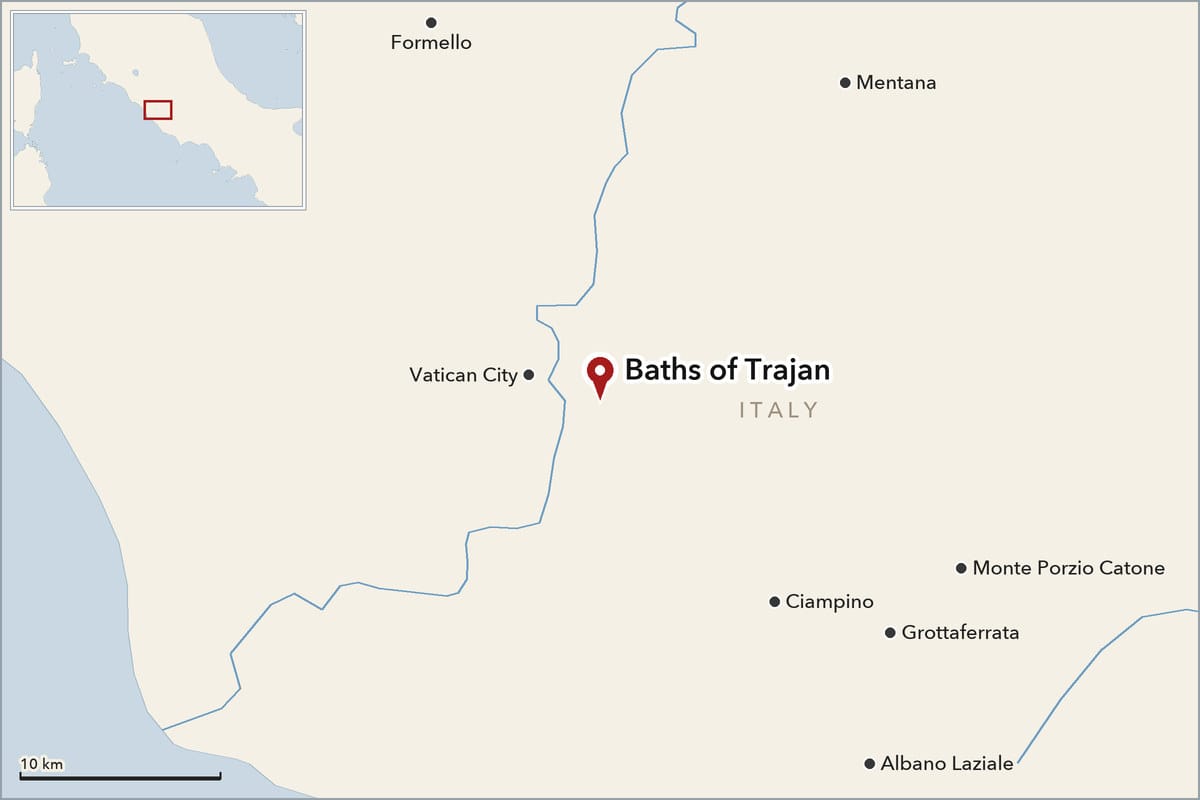
The release says public opening would begin on an experimental basis, on some days only and in small groups, so that the effect of human presence on the delicate works can be monitored and evaluated. For September it set out free guided visits, in Italian and by reservation, at weekends from Saturday 12 and Sunday 13; from 2 October, visits would run Friday to Sunday. Six slots a day were planned, at 10:00, 11:00, 12:00, 13:00, 14:00 and 15:00, with a maximum of 15 people per slot. The release recommends booking on 060608. The site is at Via del Monte Oppio, at the corner of Via delle Terme di Tito.
Art in Context adds two details from its own reading of Rome's visitor information, as of its 10 September piece. It says the September dates were listed as sold out, and that admission is charged from October, with a full nonresident ticket listed at €7.50. It also attributes to the Associated Press the statement that the small-group arrangement is meant to test how the works respond to increased humidity and other climatic effects. The release itself speaks only of monitoring the impact of human presence.
On 20 October, CGTN reported that the Painted City and the Great Mosaic, discovered in the 1990s, were now open to the public.
What to make of it
The restoration is documented in detail, and the new mosaic band and the marble niche are real additions to what is known about the room. The headline figures are the weak point. Where coverage and the official release disagree, as with the mosaic's height and its levels, the release's figures should carry more weight. Where only a news report speaks, as with the Claudius suggestion, it should be read as that outlet's report, not as the finding of the excavators.
Sources
CGTN (2026) 'Rome unveils extraordinary ancient fresco and mosaic hidden beneath the city', CGTN, 20 October 2026, available at: https://news.cgtn.com/news/2026-10-20/Rome-unveils-ancient-fresco-and-mosaic-hidden-beneath-the-city-1Ro9ag8HaQo/share_amp.html (Accessed: 22 October 2026).
Cicinelli, I. and Salako, T. (2026) 'Roman revelation: Biggest ancient monumental wall mosaic unveiled after 2,000 years', Euronews, 9 September 2026, available at: https://www.euronews.com/2026/09/09/new-baths-of-trajan-museum-opens-great-mosaic-and-painted-city-restored (Accessed: 22 October 2026).
Comune di Roma / Roma Capitale, Ufficio Stampa (2026) 'Caput Mundi, Terme di Traiano: concluso l'intervento di riqualificazione dell'esedra e della galleria sotterranea di Colle Oppio', comunicato stampa, 8 September 2026, available at: https://www.comune.roma.it/web-resources/cms/documents/riqualificazione_terme_di_traiano.pdf (Accessed: 22 October 2026).
Meyer, I. (2026) 'Rome Opens the Restored Painted City and Great Mosaic at the Baths of Trajan', Art in Context, 10 September 2026, available at: https://artincontext.org/baths-of-trajan-painted-city-great-mosaic-restoration/ (Accessed: 22 October 2026).
Picture credits
- Top picture: An exedra of the Baths of Trajan on the Oppian Hill. Exedra of the Baths of Trajan, photo by Rabax63 (CC BY-SA 4.0), via Wikimedia Commons
- Map: drawn from Natural Earth (public domain) and Wikidata.
