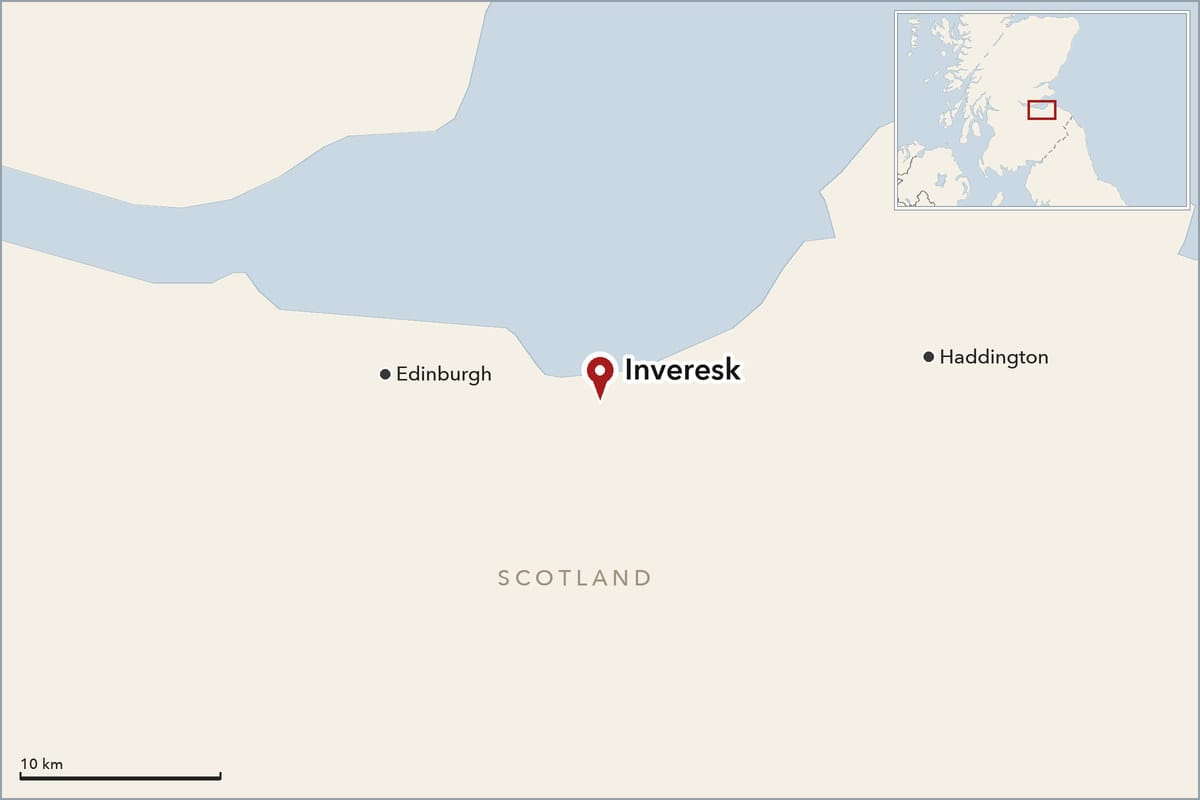
On 20 October 2026, National Museums Scotland (NMS) published a face: that of a man who died at the Roman frontier site of Inveresk, near Edinburgh, almost 2,000 years ago. NMS says it brought together an international team to build the picture. The work comes ahead of the exhibition Roman Scotland: Life on the Edge of Empire, which opens on 14 November 2026.
What the team says about him
According to NMS, scientific analysis points to a man most likely in his early 50s when he died, sometime between AD 140 and 165. He was born in southern Britain and had travelled hundreds of miles to the shores of the Firth of Forth.
NMS describes a hard, physically active life. His age would have shown in lines around his brown eyes and in greying dark hair.
The skeleton records several injuries:
- His nose had been broken and had healed.
- He had limited use of his right arm. Extensive bone growth around the elbow joint was probably caused by septic arthritis.
- Heavy wear on his front teeth suggests he made up for the weaker arm by holding objects between his teeth.
NMS says it does not know his occupation. It does say he was not a soldier when he died, "as he could not have swung a sword". NMS does not say whether he had served earlier in life.
Four of six adult men
The man belongs to a series of burials from around the Roman fort at Inveresk. NMS notes that burials are rarely discovered in Roman Scotland. These are unusual for a further reason: four of the six adult men buried there were decapitated after death.
NMS says the practice is seen across Britain. The Inveresk burials are the first Scottish examples and are among the earliest known in Britain. The museum says the reasons are hard to identify and probably changed over time. It lists three possibilities: punishment, beliefs about the way a person died, or supernatural concerns. NMS does not choose between them.
How the face was built
The reconstruction draws on three strands of work, according to NMS:
- an osteoarchaeological assessment carried out at NMS;
- earlier isotopic analysis led by scholars at Durham University;
- ancient DNA work by a team based at the Department of Archaeology at the University of York and Harvard Medical School.
Dr Chris Rynn combined these findings to estimate the man's appearance. Dr Jess Thompson, Curator of Osteoarchaeology at NMS, said the reconstruction "unites cutting-edge science with artistic vision to create an instant connection with the past". She also called the Inveresk burials "exceptional and incredibly rare survivals from Roman Scotland".
Dr Fraser Hunter, NMS's Principal Curator of Prehistory and Roman Archaeology, has worked with finds from Roman Inveresk for years. He said the reconstruction finally gave him a sense of what one of its inhabitants looked like. He was also open about the limits: "We cannot know how exactly he looked, but we think his family and friends would have spotted the likeness."
That caveat matters. The analysis of his skeleton, his isotopes and his DNA tells us a good deal: his likely age, his origin and his injuries. The face itself is still an estimate, and NMS presents it as one.
On show from 14 November
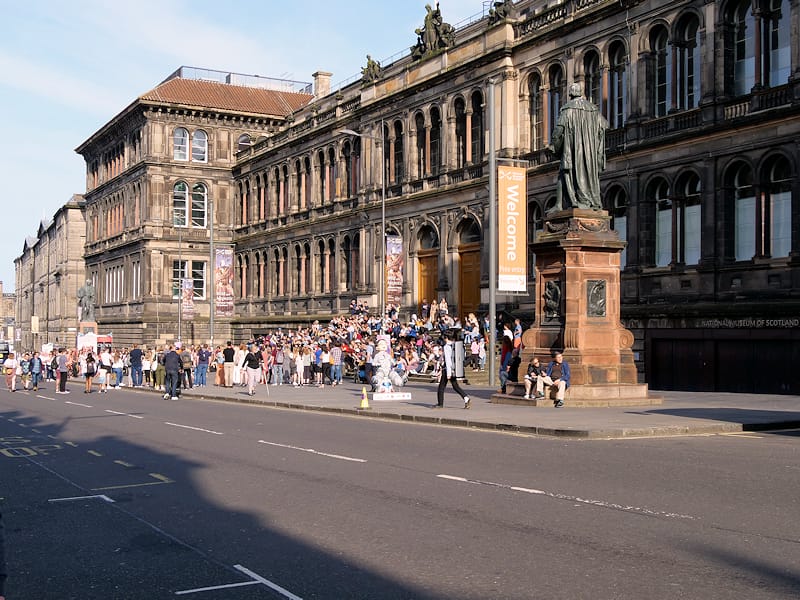
The man's skull will be displayed alongside the digital facial reconstruction in Roman Scotland: Life on the Edge of Empire. The exhibition runs from 14 November 2026 to 18 April 2027 at the National Museum of Scotland, Chambers Street, Edinburgh. NMS says it will look at life on a frontier, covering the soldiers who tried to conquer the land, the families and communities around each military base, and the local people whose lives and lands were threatened by the Roman invasion.
Sources
National Museums Scotland (2026) '2000-year-old face of Roman Scotland inhabitant revealed in new reconstruction', National Museums Scotland News, 20 October 2026, available at: https://media.nms.ac.uk/news/2000-year-old-face-of-inhabitant-of-roman-scotland-revealed-in-new-reconstruction (Accessed: 21 October 2026).
Picture credits
- Top picture: The National Museum of Scotland, Chambers Street, Edinburgh, where the exhibition runs from 14 November 2026. Image: The National Museum of Scotland, Chambers Street — David Dixon, CC BY-SA 2.0 (via Wikimedia Commons)
- Map: drawn from Natural Earth (public domain) and Wikidata.
