
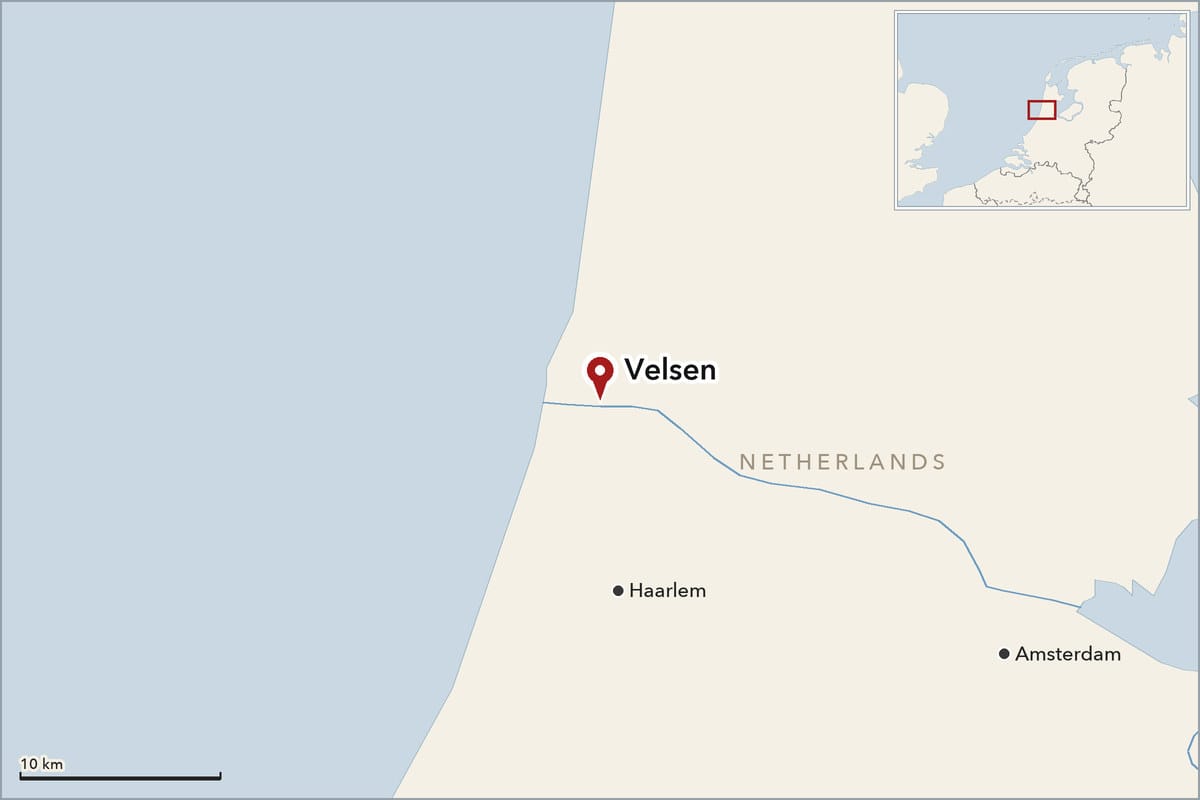
In 1977, amateur archaeologists dug out a well on the site of the Roman fort of Velsen, in the Netherlands. At the bottom lay the almost complete skeleton of a man, with a military belt, a dagger, a ring, a brooch and a soldier's sandal. According to Leiden University, archaeologists and historians have speculated about his fate ever since.
On 26 October 2026 the university announced the latest attempt to answer the question. In their new book, Victims of Violence from the Early Roman Fort Velsen, Leiden archaeologists Carol van Driel-Murray and Mark Driessen reconstruct how the man died. The approach combines archaeological, historical and forensic evidence.
The Tacitus problem
The find was soon connected to a passage in the Annals of the Roman historian Tacitus. Leiden's account says Tacitus described the Frisians rising in revolt in AD 28, when the Romans demanded higher taxes. A murdered man in a fort's well fits that story easily.
Driessen and Van Driel-Murray did not want to accept the link as it stood, because it lacks empirical evidence. "Written sources and archaeological finds often tell different stories", Van Driel-Murray notes. Leiden's account gives an example: ancient sources assume the Romans withdrew from the area north of the Rhine around the year 28, while archaeological finds indicate a much longer presence.
Reopening the file
Over several years, a team of archaeologists, specialists and students re-examined the remains. Their methods included isotope, forensic and osteoarchaeological analysis, and 3D imaging.
They found further evidence of stab wounds, including on the inside of the ribcage, and numerous perforations in the pelvis. Using 3D models, they reconstructed how the wounds were made. The researchers say the wounds were most probably caused by a Roman military dagger, presumably the one that lay with the man in the well.
Driessen says: "Forensic experts said this was a very brutal murder". He goes on: "It must have been a furious and targeted act of revenge." He believes that makes a defensive fight at the fort a much less likely cause of death.
Who was he?
The researchers think he was more likely a regular soldier than an officer. His dagger was worn and his belt was assembled from different pieces, while the dagger sheath was, in Leiden's words, pure Roman bling.
He stood at around 1.90 metres, which Leiden describes as surprisingly tall for the time, and he was very muscular. Archaeologists in the early 1980s had therefore suggested he might have been a Frisian. The team's isotope analysis of his tooth enamel points elsewhere: it indicates a childhood spent in Southern Europe.
Several scenarios, one favourite
The book does not pick a single culprit by default. "We're trying to solve an ancient murder with modern methods and are not choosing one theory", Driessen says. He argues that a case with human actors is more accurately handled with several scenarios than with one explanation.
Leiden's account describes three:
- The Frisians killed him during an attack on the fort, for example out of anger about taxes, as Tacitus described.
- He was a deserter executed by the military command.
- One or more members of the local population murdered him in retaliation.
Driessen and Van Driel-Murray think it most likely that fellow soldiers killed him in retaliation for misconduct. Van Driel-Murray admits there is no such thing as absolute certainty. The authors invite readers to reach their own conclusion, and say they would like to pass the story to a writer of historical fiction.
It is a measured way to close a file. The team puts a preferred answer on the table, names the evidence that weakens the tidy tax-revolt story, and leaves the other options in view.
What happens next
The research does not stop with the publication: Driessen says many other skeletal remains and archaeological finds from the Roman settlement at Velsen deserve study. According to Leiden, the skeleton is back in storage at the Dutch National Museum of Antiquities in Leiden. The museum hopes to include the story in its future permanent exhibition, in the section on the Netherlands during the Roman Empire.
Sources
Leiden University (2026) 'Solving an ancient cold case: Roman was brutally murdered', Leiden University, 26 October 2026, available at: https://www.universiteitleiden.nl/en/news/2026/10/solving-an-ancient-cold-case-roman-was-brutally-murdered (Accessed: 30 October 2026).
Picture credits
- Top picture: The Dutch National Museum of Antiquities in Leiden. Image: Rijksdienst voor het Cultureel Erfgoed (RCE), via Wikimedia Commons, CC BY-SA 4.0
- Map: drawn from Natural Earth (public domain) and Wikidata.
