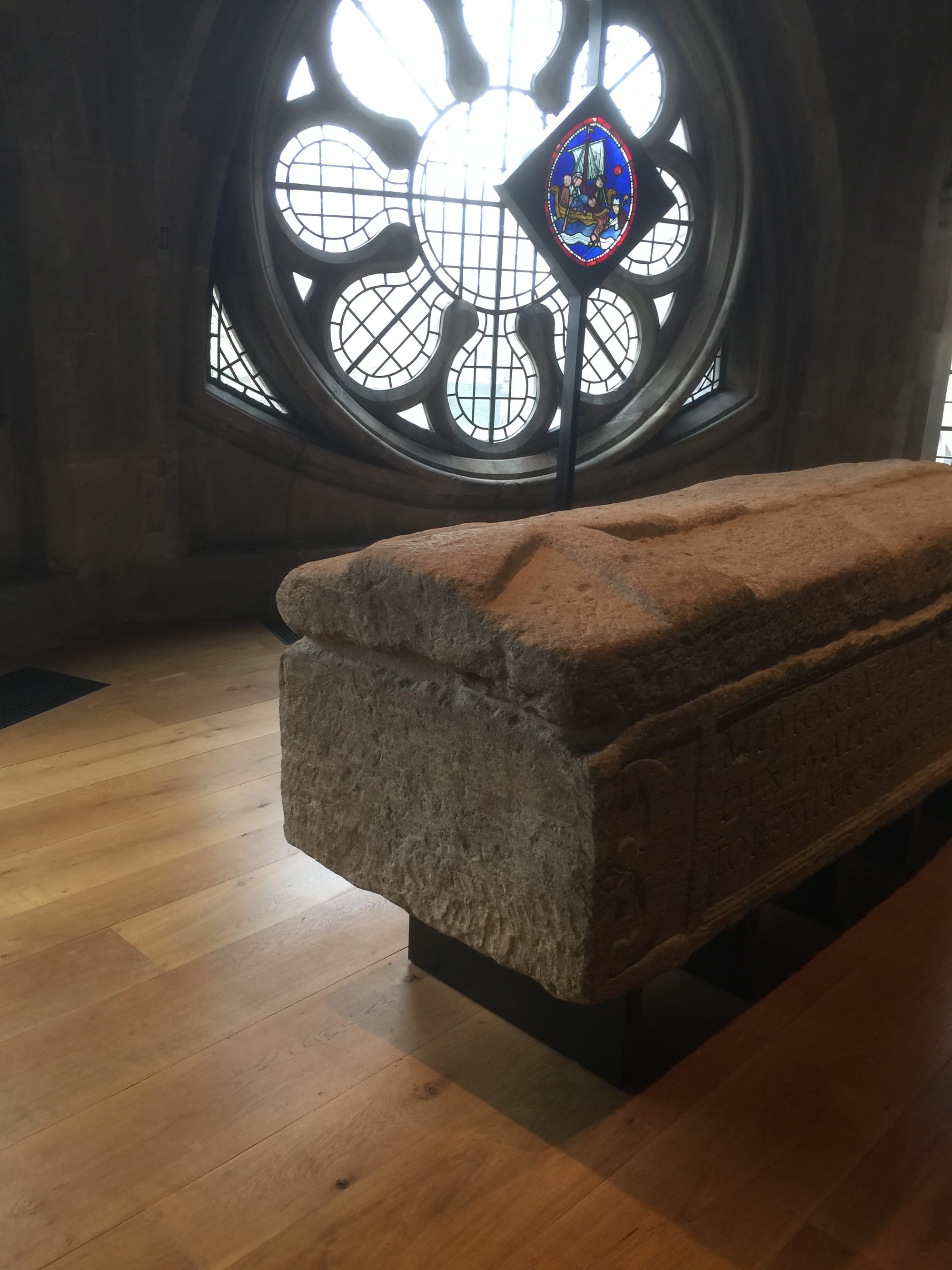
The file on this one has been open since 1869. A stone coffin came out of the ground beside Westminster Abbey with a Roman name cut into it and a Christian cross cut into its lid, and the cross suggested that the skeleton inside belonged to someone who died many centuries after the Roman it commemorated. On 21 October 2026, Westminster Abbey announced that the mystery of the man's identity "appears closer to being solved", and the answer is a pair of suspects rather than a single name.
The coffin that says two things
The limestone sarcophagus was excavated on the Abbey's North Green in 1869. Its inscription commemorates Valerius Amandinus, whom the Abbey describes as a wealthy Briton who lived in the city around AD 300 to 400. In Smithsonian Magazine's translation, the text records that two men, Valerius Superventor and Marcellus, made it for their father.
The lid tells a different story. It carries a Latin cross dated to the 10th or 11th century, from when the coffin was reused. According to Westminster Abbey, who was buried in it then has been a mystery ever since.
A skeleton that was thought to be lost
The sarcophagus has a long record of being disturbed. According to Taylor & Francis, the publisher of the Journal of the British Archaeological Association, workmen unearthed it by accident in 1820 and smashed the lid into six pieces. The damage was repaired when the coffin was officially discovered in 1869.
Professor Warwick Rodwell, the Abbey's Consultant Archaeologist, writes in his paper that the skeleton had been believed lost. That turned out to be wrong when the stone coffin was sent to a conservation studio in 2016. When researchers from Pre-Construct Archaeology (PCA) lifted the lid, they found an almost-complete skeleton inside.
What the bones say
The Abbey says the skeleton was assessed by human bone specialist James Young Langthorne of PCA, who put the man's age at death between 35 and 49 and his height at around 5ft 9in. That differs from an assessment made in the 1800s, which described a "robust young man", around 5ft 7in and no more than 30. Live Science, reporting on the study, adds that Langthorne's 2016 report recorded some evidence of osteoarthritis, two healed rib injuries and gout.
A bone sample sent to the Scottish Universities Environmental Research Centre for carbon dating returned a date of 987 to 1052 AD. Rodwell says this "confirms that the reuse of the sarcophagus, and the associated remodelling of its cover, occurred in the late Saxon period."
Why an abbot
The reasoning leans on rank as much as on bones. The Abbey's account says the occupant was "honoured" with burial in a "fine sarcophagus", with a wooden coffin placed inside the stone one and the lid re-carved with a large Latin cross. Smithsonian Magazine reports Rodwell's conclusion that this implies the man was "almost certainly an abbot". It also quotes what he told the Guardian: "Nobody of lower rank would have been buried in anything like that."
The timber coffin has left no remains of its own. Rodwell reports that researchers in 2016 found a rectangular outline in the sarcophagus, picked out in white residue left by lime. He writes that although no physical traces remained, it "can only have been a timber coffin, which has completely decayed".
The paper puts forward two candidates:
- Aelfwig, abbot of the Benedictine monastery at Westminster, who died around 1020. Rodwell calls him the most likely.
- Wulnoth (also spelled Wulfnoth), Aelfwig's successor, who died in 1049.
In the Abbey's release, Rodwell says: "We have two viable contenders for the occupant of the sarcophagus. We do not know the date of birth of either. But either would fit equally well if we assume the Abbot was in his early twenties when the appointment was made and close to fifty when he died. The fact Aelfwig was already a monk of Westminster might favour him."
Rodwell also considered a third abbot, Wulfsige, who held office from 988 to 993, but he left Westminster to become a bishop elsewhere and was likely not buried at the Abbey.
How firm is it?
The wording is hedged. Smithsonian Magazine reports that Rodwell writes the question "cannot be answered with certainty". Aelfwig is described as the likelier candidate, not as established.
My own reading is that the radiocarbon range cannot settle it: 987 to 1052 spans the deaths of both men, around 1020 and 1049. The tilt towards Aelfwig rests on his having been a monk of Westminster already, which is a reasonable inference and not a measurement.
Questions still open
Live Science reports that Rodwell notes the reuse of Roman coffins is extremely unusual, with nothing comparable to this sarcophagus found. Live Science also says the stone is limestone sourced from Oxfordshire, and that nobody is sure where the coffin originally stood. Smithsonian reports Rodwell's suggestion that it came from a mausoleum elsewhere, where it would have sat in a wall recess with only its inscribed front and lid visible.
Rodwell also writes, as quoted by Live Science, that "there could be a villa and its cemetery somewhere in the vicinity of Westminster Abbey, awaiting discovery."
The sarcophagus is on public display in the Queen's Diamond Jubilee Galleries at Westminster Abbey.
Sources
Killgrove, K. (2026) 'Case of mysterious medieval skeleton buried in Roman-era sarcophagus at Westminster Abbey finally solved', Live Science, 20 October 2026, available at: https://www.livescience.com/archaeology/case-of-mysterious-medieval-skeleton-buried-in-roman-era-sarcophagus-at-westminster-abbey-finally-solved (Accessed: 27 October 2026).
Rodwell, W. (2026) 'Westminster Abbey's Roman sarcophagus and its afterlife', Journal of the British Archaeological Association, 21 October 2026, available at: https://tandfonline.com/doi/full/10.1080/00681288.2026.2675788 (Accessed: 27 October 2026).
Solly, M. (2026) 'Archaeologists May Have Solved the Mystery of a Roman Sarcophagus Excavated at Westminster Abbey in 1869', Smithsonian Magazine, 21 October 2026, available at: https://www.smithsonianmag.com/smart-news/archaeologists-may-have-solved-the-mystery-of-a-roman-sarcophagus-excavated-at-westminster-abbey-in-1869-180989732/ (Accessed: 27 October 2026).
Taylor & Francis Group (2026) 'Mystery skeleton found in Roman sarcophagus at Westminster Abbey may finally have an identity', Taylor & Francis Newsroom, 19 October 2026, available at: https://newsroom.taylorandfrancisgroup.com/mystery-skeleton-found-in-roman-sarcophagus-at-westminster-abbey-may-finally-have-an-identity/ (Accessed: 27 October 2026).
Westminster Abbey (2026) 'Mystery of Abbey's Roman sarcophagus solved', Westminster Abbey, 21 October 2026, available at: https://www.westminster-abbey.org/abbey-news/mystery-of-abbeys-roman-sarcophagus-solved/ (Accessed: 27 October 2026).
Picture credits
- Top picture: The sarcophagus, with the cross carved on its lid. Photo: Maggie Jones (Public Domain Mark), via Wikimedia Commons
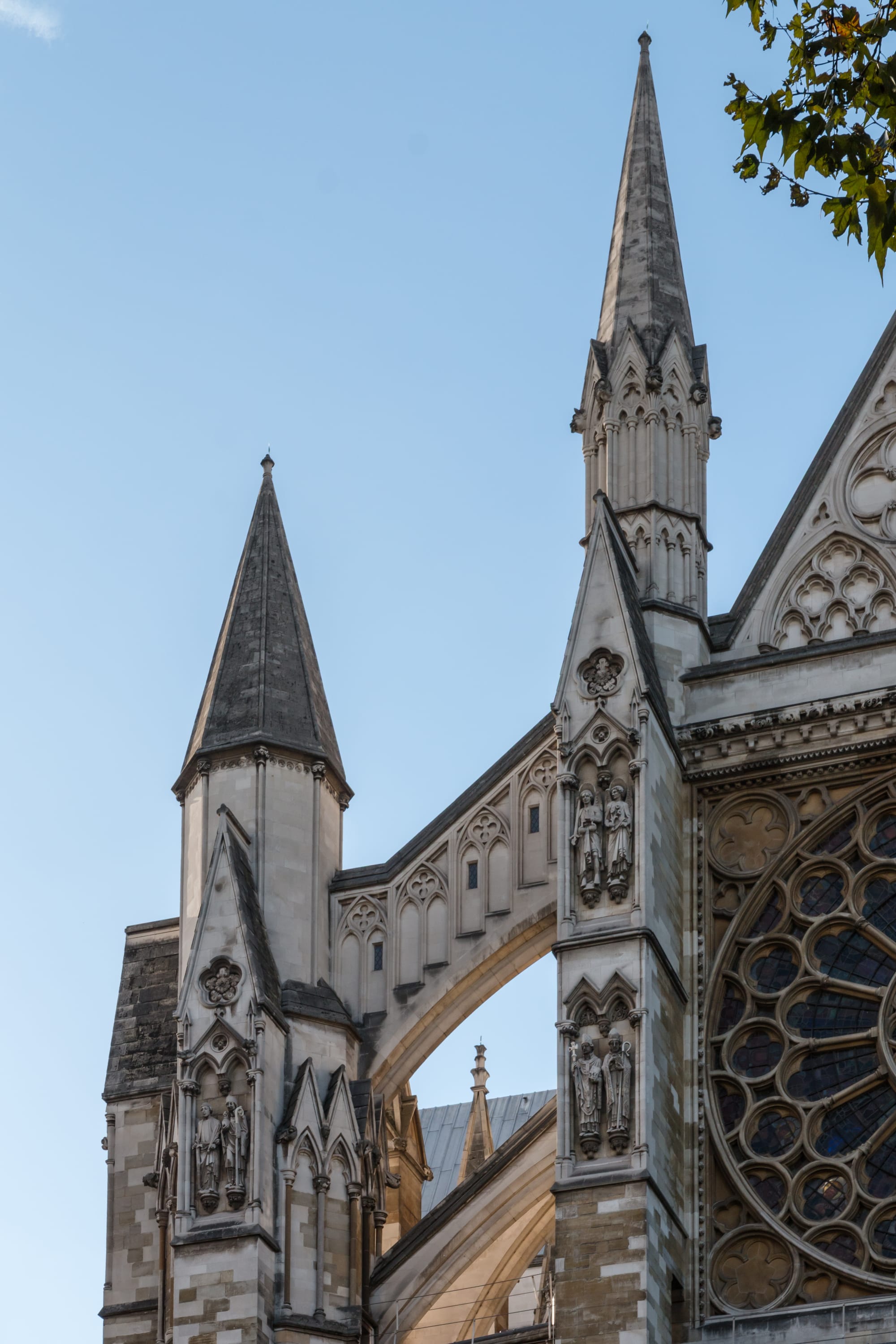
- Photo: Dietmar Rabich, CC BY-SA 4.0, via Wikimedia Commons

