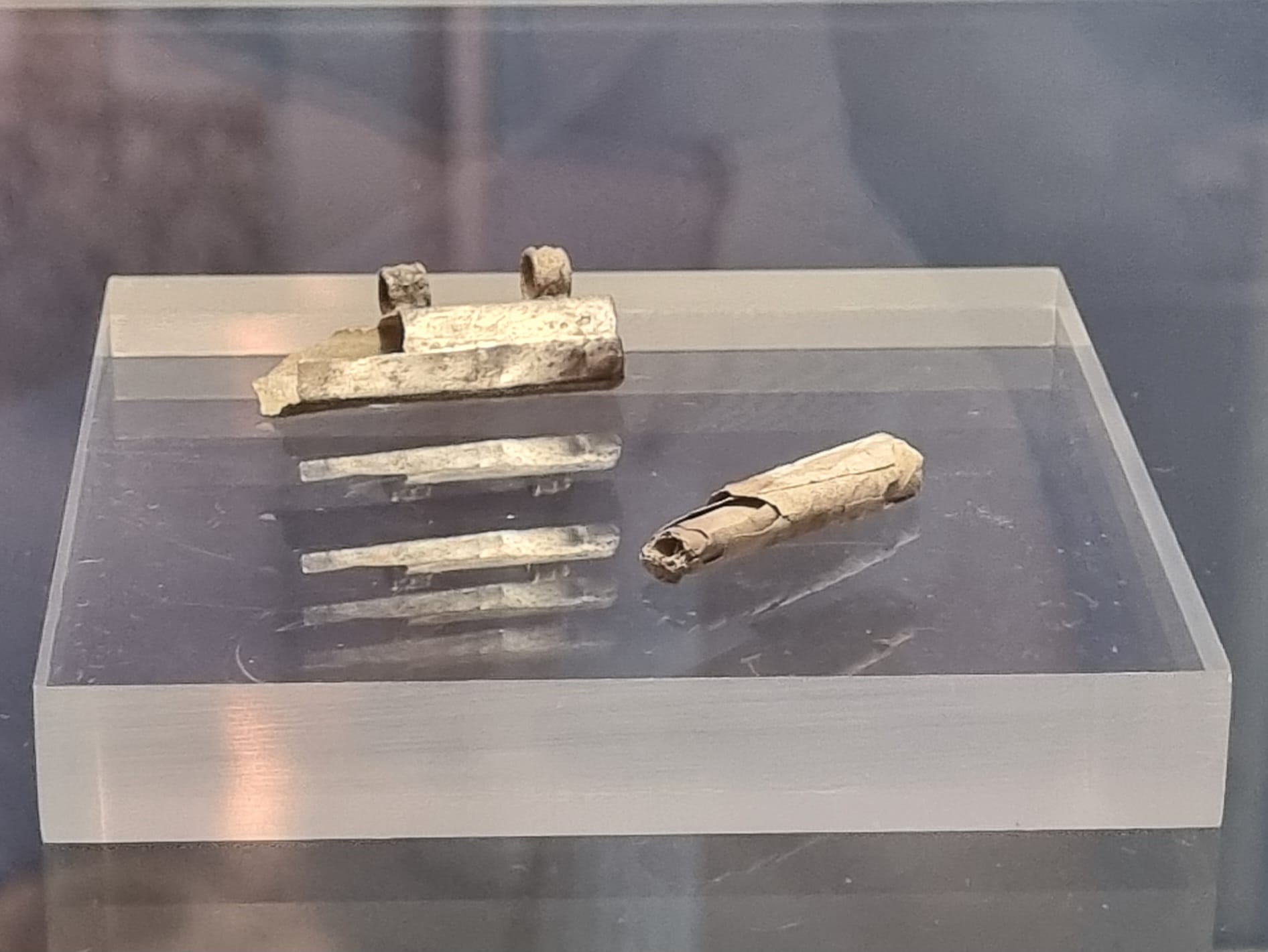
In 2018, archaeologists excavating a Roman-period burial ground in Frankfurt-Praunheim found a man, aged roughly 35 to 45, with a small silver capsule lying beneath his chin. Inside was a rolled sheet of silver with an inscription cut into it. It took until 2024 to read.
The words are a prayer to Jesus. What they tell us about the man buried with them is a separate question, and it is the one Santiago Guijarro, a scholar of early Christianity at the Universidad Pontificia de Salamanca, has been pressing.
The object and where it lay
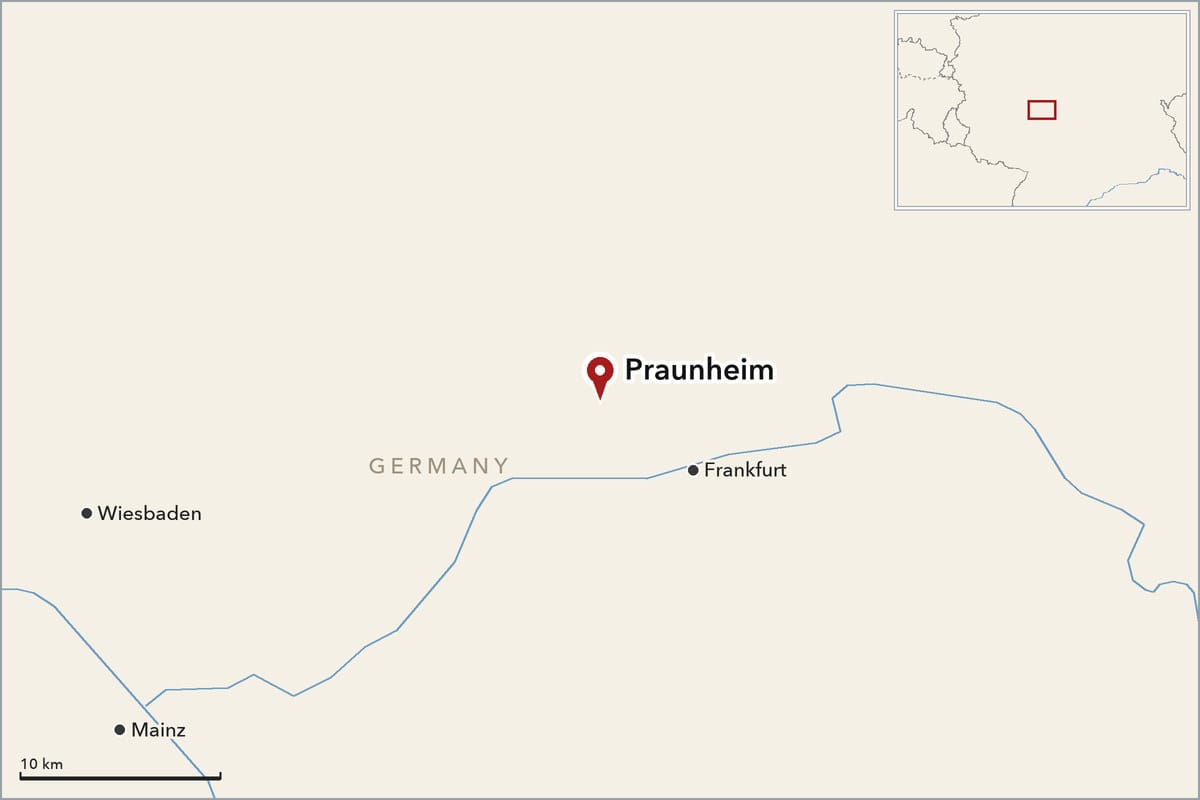
The grave, number 134, was in a cemetery on Heilmannstraße. According to Wikipedia's summary of the find, the cemetery lies on the north-western edge of Nida, a Roman town that was capital of the civitas Taunensium in the province of Germania Superior. The Heritage Office of the City of Frankfurt investigated it in 2017 and 2018.
The capsule is 3.5 cm long and has small eyelets on one side for a cord or strap. The silver foil inside was wafer-thin and badly damaged. Material analysis in 2019 showed that the foil carried writing, but nobody could read it. In May 2024, high-resolution CT scans and virtual smoothing of the crumpled foil at the Leibniz Center for Archaeology in Mainz (LEIZA) captured the whole inscription. It runs to 18 lines and is about 9 cm long.
The dating rests on the grave goods. Wikipedia reports that a censer and a ceramic vessel found in place point to a burial between roughly 230 and 260 AD. Popular Mechanics, reporting the Frankfurt Archaeological Museum's dating, says the same range rests on the age of a clay jug and an incense burner. The abandonment of Nida by 275/280 AD at the latest supplies a hard upper limit.
What the inscription says
Reading it is difficult. Wikipedia notes that the text is accessible only through CT, which makes it hard to tell the direction of the cuts that identify individual letters. There are also large gaps, especially at the starts of lines. Markus Scholz published the first palaeographic reconstruction and transcription; Guijarro has since proposed his own reading.
On Guijarro's reading, as Wikipedia sets it out, the text falls into four parts:
- An invocation of a Saint Titus opens it.
- A threefold agios, "holy", Greek written in Latin letters, follows within that opening invocation.
- An invocation of Jesus Christ as Son of God and "Lord of the world" follows, and then a request that the amulet protect its wearer.
- It closes with a quotation of Philippians 2:10–11, about every knee bending before Christ.
Wikipedia calls this the earliest extant Latin version of that passage. It also reports that, whereas many early Christian amulets mix Christian and pagan elements, the protective invocation here is directed exclusively to Jesus Christ.
The metal matters too. Wikipedia reports that curse texts were typically cut into lead, while protective texts were preferred on more precious metals, so silver signals protection.
One name nobody can place
Titus is a puzzle. The text opens with an invocation of him, most plausibly the companion of the Apostle Paul. Wikipedia says calling on saints was still uncommon in the mid-third century. Popular Mechanics quotes Guijarro calling the reading "frankly, puzzling", because the known traditions honouring Titus as a saint come much later.
The question about the man
The headline reading is that the inscription is among the earliest material testimonies of Christianity north of the Alps. That is how Wikipedia's summary describes it.
Guijarro's contribution, as Popular Mechanics reports it, is to separate the text from the person who wore it. Around 250 AD, Emperor Decius required the inhabitants of the empire to sacrifice to the Roman gods. Papyri from Egypt preserve officials' signed statements that they had witnessed sacrifices. Popular Mechanics reports that some Christians went through with the ritual and others found ways to obtain the paperwork without sacrificing. Cyprian, bishop of Carthage, wrote about the lapsi, the "lapsed", asking whether someone had sacrificed willingly or under pressure, and distinguishing performing a sacrifice from obtaining a certificate without one.
For Guijarro, those arguments show that holding Christian beliefs and complying in public were not always mutually exclusive. For someone only loosely tied to a Christian community, he says, "It is not obvious that such a person would have understood compliance with the imperial order as a betrayal of anything." On the wider picture he says: "In the third century, the boundaries of what we call Christianity were considerably more porous than later ecclesiastical literature suggests."
He also separates the author from the wearer: "The content tells us about the person who composed or wrote the text; it tells us rather less about the person who wore it." Popular Mechanics reports that he allows the man might have belonged to a Christian community, or might have received the object as a gift from a Christian without being one himself.
Popular Mechanics notes that the burial could predate Decius's order, or the man could have lived through the persecution that followed, and that there is no way to tell whether he was ever asked to sacrifice. It also notes that sacrifice was part of religious life in Nida itself. A January 2026 Goethe University announcement, as Popular Mechanics describes it, mentions a large sanctuary there with remains interpreted as offerings and ritual meals, and a dedication to a god dated 246 AD.
Who made these things?
Popular Mechanics adds a later footnote. A late-antique canon attributed to the Council of Laodicea forbade clergy to make amulets and ordered the exclusion of anyone who wore one. Guijarro reads the ban's focus on clergy as a sign that the practice had already taken hold inside the church. The canon comes more than a century after the Frankfurt man's burial, so it cannot say who supplied his amulet.
Where the evidence stands
Guijarro's study appeared in Isidorianum in 2025. The preprint's abstract says the study examines three especially significant aspects of the text: its possible link to the Pauline tradition, its concentration on Christology, and its place within what it calls "religión vivida" (lived religion). The abstract also says the text and its context show the discovery's importance for understanding nascent Christianity.
My own reading is this. Nothing in the evidence settles whether the man thought of himself as a Christian, and Guijarro does not claim it does. His point is narrower and, to my mind, sound: the inscription proves that a Christian prayer was in Nida, but how its wearer understood himself is a different question that the silver alone cannot answer. The tidy story is a believer buried with his creed. The evidence supports something more modest, a prayer to Jesus worn by a man whose own convictions are not recorded.
Sources
Guijarro Oporto, S. (2025) 'El Amuleto de Frankfurt: Cristianismo popular en el Limes Germanicus', Isidorianum 34/1, pp. 25–48, DOI: 10.46543/ISID.2534.1004. Preprint available at: https://zenodo.org/records/15524367 (Accessed: 21 October 2026); a newer version of the Zenodo record exists.
Spitznagel, E. (2026) 'A Man Took a Hidden Prayer to Jesus to His Grave—It Could Rewrite Christianity's Origin Story', Popular Mechanics, 19 October 2026, available at: https://www.popularmechanics.com/science/archaeology/a74158508/he-wore-a-prayer-amulet/ (Accessed: 21 October 2026).
Wikipedia contributors (n.d.) 'Frankfurt silver inscription', Wikipedia, revision 1363143051, available at: https://en.wikipedia.org/wiki/Frankfurt_silver_inscription (Accessed: 21 October 2026).
Picture credits
- Top picture: The Frankfurt silver amulet capsule and its rolled foil. Photo: Hagios397Martin, CC BY-SA 4.0, via Wikimedia Commons
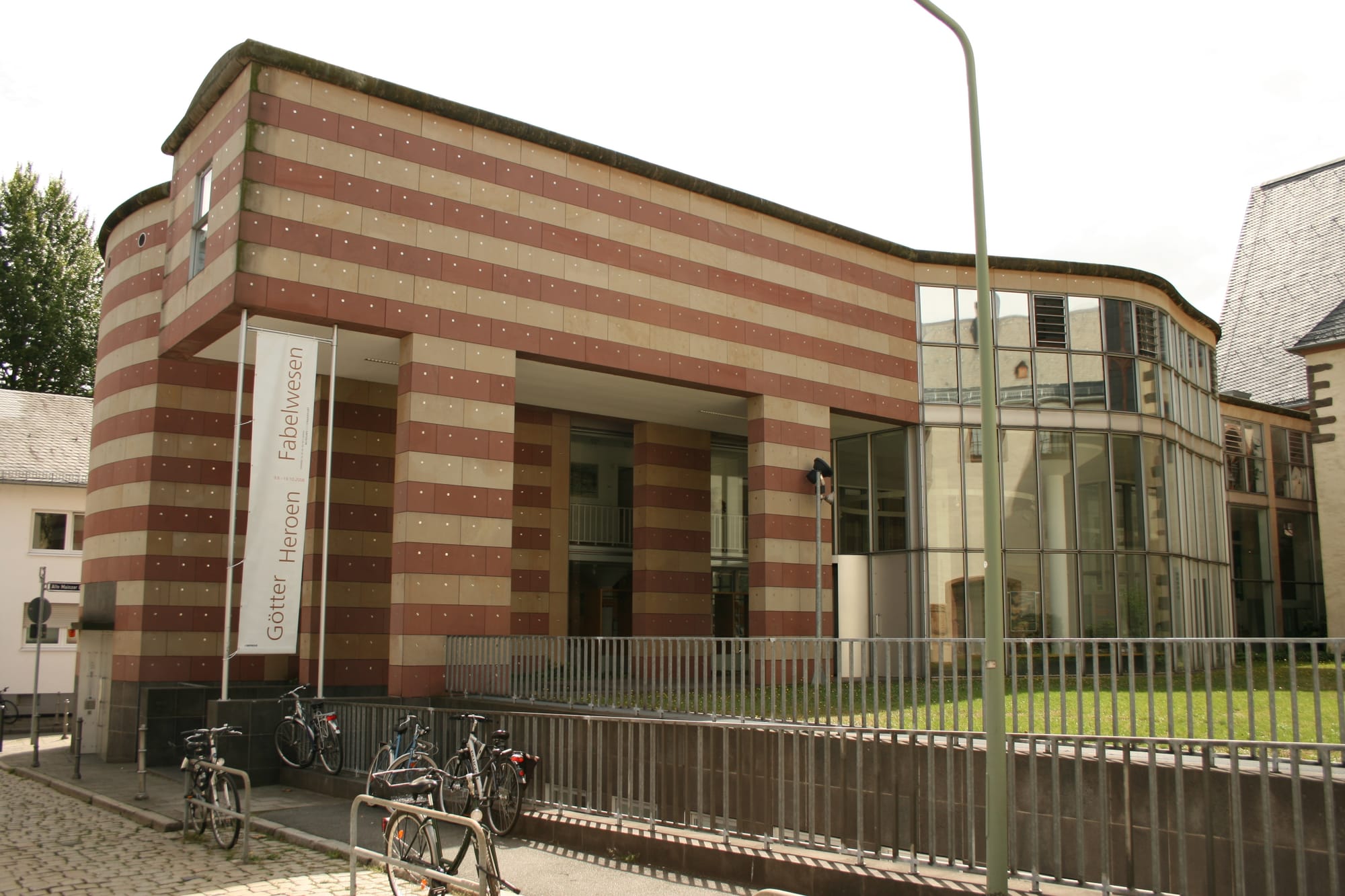
- The Archaeological Museum in Frankfurt am Main. Photo: Haselburg-müller, via Wikimedia Commons (CC BY-SA 3.0)
- Map: drawn from Natural Earth (public domain) and Wikidata.

