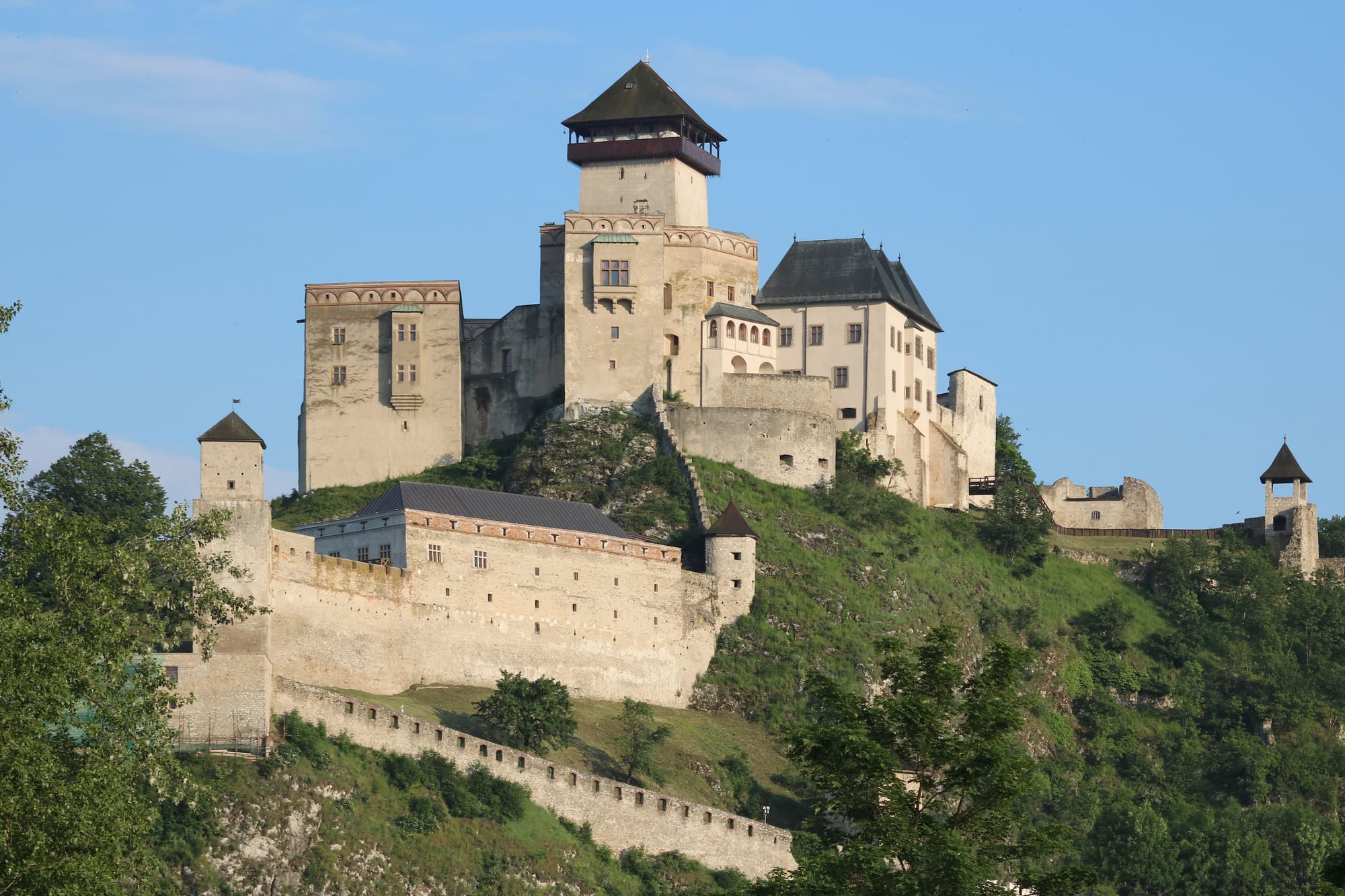
Above: Trenčín Castle, western Slovakia. A Roman inscription of AD 179 is carved into the castle rock. (Trenčín Castle, photo: Ingo Mehling (CC BY-SA 4.0), via Wikimedia Commons)
A Roman marching camp has been found at Šurany, in the Nitra region of Slovakia. What makes it unusual is less the ground plan than what was left in the ditches, pits and wells: human remains, Roman military equipment, and a set of questions the excavators say they cannot yet answer.
What the Slovak Academy of Sciences announced
The Institute of Archaeology of the Slovak Academy of Sciences (SAS) announced the find on 20 July 2026. The camp lies in the southern part of the planned Šurany Industrial Park and covers about 7.4 hectares. The institute dates it to the second half of the 2nd century AD, most likely the period of the Marcomannic Wars (166 to 180 AD).
The camp is part of a much larger dig. The SAS says its researchers have explored more than 150 hectares of the industrial park, and said in July that excavations were under way on a further 5 hectares in cooperation with MH Invest. It describes the project as one of the largest archaeological investigations ever carried out in Slovakia. Excavation began in March 2025 and is financed by MH Invest, s.r.o.
Matej Ruttkay, Director of the Institute of Archaeology, calls it "the first Roman military camp discovered in the Nitra region". He says it fills a gap in what is known about Roman activity north of the Danube in the last third of the 2nd century. He also says the industrial park development made it possible to dig almost the whole camp, which he calls an extremely rare find in a European context. In his view, research on this scale would otherwise have been virtually impossible, given fragmented land ownership, limited access and the cost.
A camp that breaks the pattern
According to the SAS, the layout is not the typical rectangle of most known Roman camps. It still has the defensive features of a marching camp: five entrance gates, fortifications, and a clavicula. The SAS describes a clavicula as a gate design with a curved ditch and rampart that forced attackers into a vulnerable approach. This is the first clavicula gate identified in Slovakia.
The SAS puts the find in a regional sequence. The earliest confirmed evidence of a Roman military presence in present-day western Slovakia is the inscription carved into the castle rock at Trenčín, dated AD 179. Šurany follows the earlier identification of a first Roman camp in the Hron River region near Želiezovce, where Marcus Aurelius is believed to have written parts of his Meditations.
The dead in the ditches
The SAS says the excavation has revealed an extraordinary number of human skeletal remains. Some are complete skeletons and some are scattered bones. They lay in defensive ditches, storage pits, wells and shallow graves.
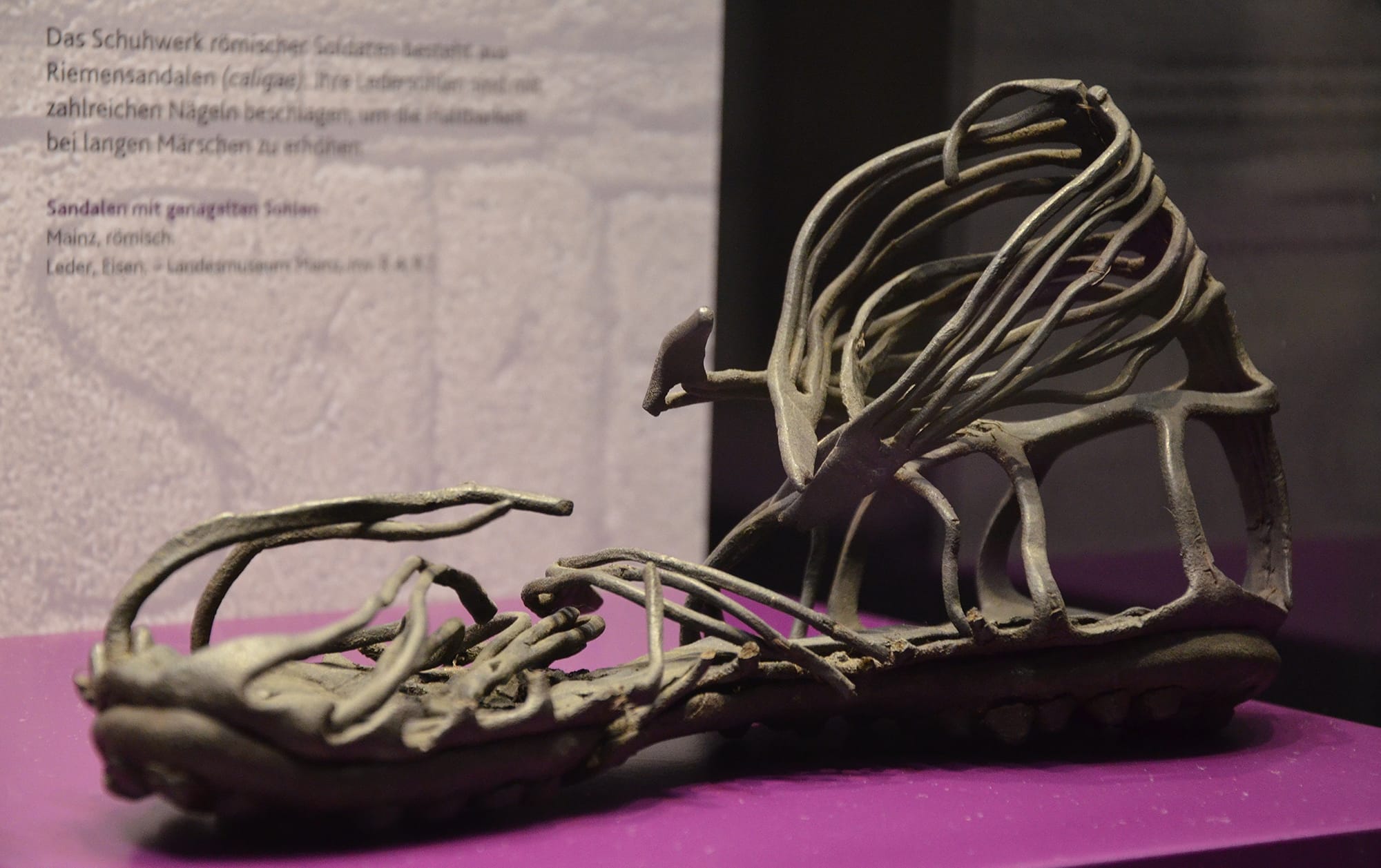
Marek Vojteček, the lead archaeologist, gave the team's preliminary reading: "Our preliminary findings suggest that many of the deceased were Roman soldiers." Beside the remains the team found spears, arrowheads, helmet fragments, segmented and scale armour, legionary belt fittings and coins. They also found caligae, the military sandals, identified by the iron hobnails preserved in their soles. Everyday objects turned up too: an axe, a knife and gaming dice.
Wording matters here. Archaeology magazine, summarising a Live Science report, wrote that "Most of these remains are thought to belong to Roman soldiers", and it listed "legionary brooches". The SAS release, which is the primary source, says "many" and "belt fittings". This article follows the SAS.
Ruttkay says the site appears to have been abandoned immediately after a military conflict between the Romans and Germanic tribes, as numerous finds demonstrate. Archaeology magazine, citing Live Science, quotes him as saying the place "disappeared immediately after the military conflict between the Romans and the Germans".
The questions the excavators are asking
The most revealing passage in the announcement is not a finding but a list of questions. Michal Cheben, a member of the research team, asks: "Who were these individuals? What caused their deaths?" He also asks why many bodies were discarded in storage pits or wells rather than given proper burials, and whether disease or combat injuries were responsible. And he asks: "Why were so many valuable objects left behind rather than looted?" He says answers may come from laboratory work and from genetic and anthropological research.
In my view, that last question is the one to watch. A camp that appears to have been abandoned immediately after a military conflict, bodies in wells, and valuable objects left behind do not obviously add up to a single story. The SAS puts forward a preliminary identification of many of the dead as soldiers, and leaves the cause of death and the reason for the disposal open.
What happens next
Most finds are being conserved and examined in the institute's laboratories. Particularly fragile ones will go to leading international laboratories once legal requirements are met. Cheben says several artefacts have been X-rayed, which showed what was inside compact blocks of soil. He singles out a Roman soldier's footwear preserved well enough that its shoe size can be determined.
Ruttkay lists the specialist work planned abroad. Radiocarbon dating is being done in laboratories in Poznań, Poland. Colleagues in the Czech Republic will analyse soil sediments under the microscope. The University of Vienna will carry out archaeogenetic analyses, and isotope analyses will be run in laboratories in Germany, Poland and likely South Africa. The SAS says the scientific evaluation will continue for several years, and Ruttkay says many results will only become available over the coming years.
Sources
Archaeological Institute of America (2026) 'Roman Military Camp Excavated in Slovakia', Archaeology Magazine, 24 July 2026, available at: https://archaeology.org/news/2026/07/24/roman-military-camp-excavated-in-slovakia/ (Accessed: 9 October 2026).
Institute of Archaeology of the Slovak Academy of Sciences (2026) 'Archaeologists Discover Roman Military Camp from the Time of Marcus Aurelius Near Šurany', Slovak Academy of Sciences, 20 July 2026, available at: https://www.sav.sk/index.php?lang=en&doc=services-news&source_no=20&news_no=13815 (Accessed: 9 October 2026).